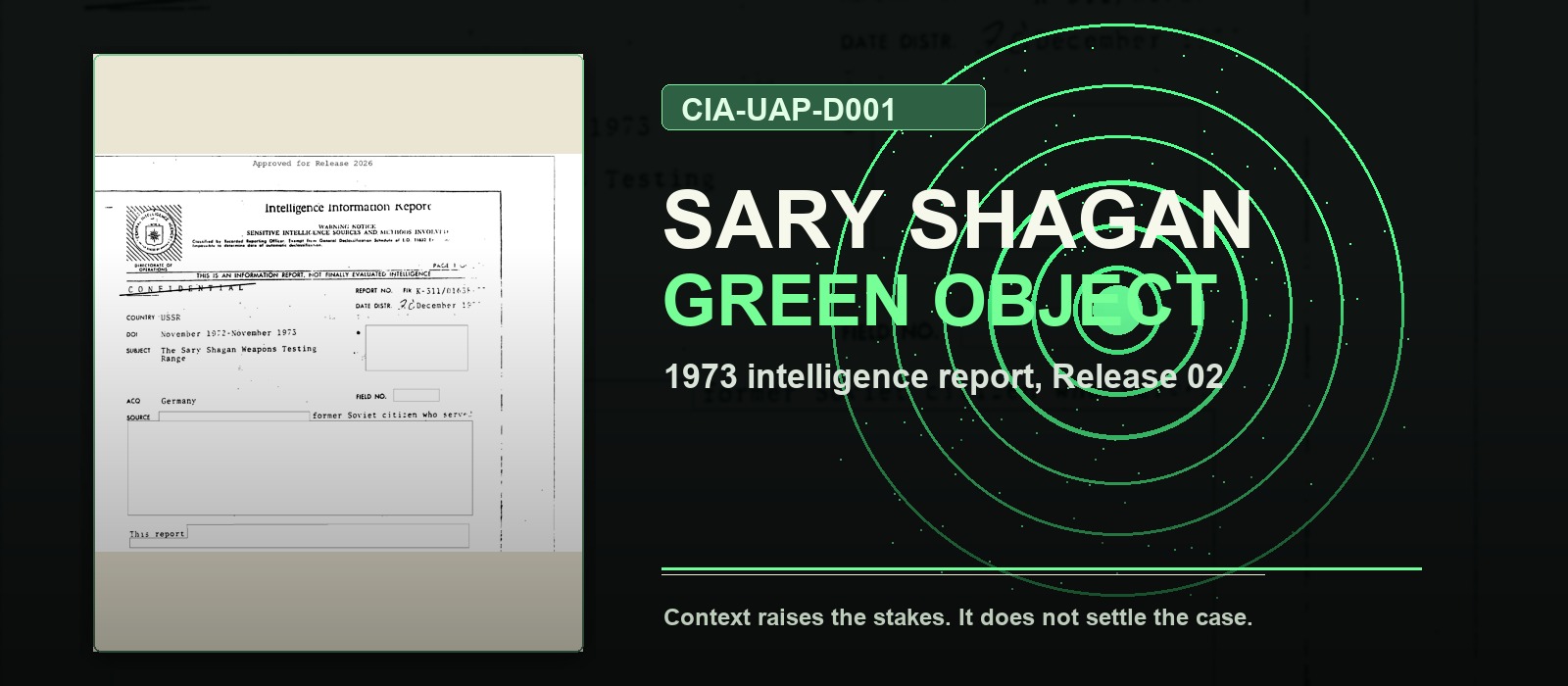
CIA Sary Shagan Green Object: Intelligence Context, Not Proof
The most interesting thing about CIA-UAP-D001 is not only the green object.
It is where the object appears.
CIA-UAP-D001, “Intelligence Information Report, USSR, 1973” is a short three-page historical record in War.gov Release 02. At first glance, the UAP portion looks almost too brief to carry much weight: one evening in late summer 1973, a source at the Sary Shagan weapons testing range reported seeing a bright green circular object or mass in the sky. It widened, formed several green concentric circles, faded within minutes, and produced no sound or explosion.
That description is memorable. It is also easy to overread.
The file is not a final identification. It is not a technical exploitation report. It is not a sensor package. It is not a conclusion that something exotic crossed Soviet airspace.
It is a human-source intelligence report about a sensitive Soviet weapons range, and the UAP account is embedded inside that wider reporting.
That makes the file important in a very specific way. It shows that an unusual aerial observation was preserved inside Cold War intelligence collection, close to an anti-missile test environment, alongside details about warhead handling, range facilities, and rumored laser work. The context raises the stakes. It does not settle the case.
For serious UAP research, that distinction is the whole point.
What CIA-UAP-D001 Is
CIA-UAP-D001 is part of the Department of War’s PURSUE archive and was included in the second public release announced on May 22, 2026. Unlike the modern military videos in Release 02, this is not imagery from a cockpit, drone, or surveillance platform. It is a declassified intelligence report.
The report’s subject is the Sary Shagan weapons testing range in the Soviet Union. Its date of information runs from November 1972 to November 1973. The source was a former Soviet citizen, and the report was acquired in Germany. The opening page frames the material carefully: it is an information report, not finally evaluated intelligence.
That warning matters.
In intelligence files, a report like this can preserve valuable observations while still leaving many questions unresolved. The source may have direct knowledge of some details, secondhand knowledge of others, and no ability to interpret an unusual event beyond what he saw. The document itself may be useful because it records what a source said, where he said it happened, and how the information moved through official channels. It does not automatically transform every included detail into verified fact.
That is the right lens for CIA-UAP-D001.
The file gives limited information about Sary Shagan: facilities, work areas, security fencing, a regional headquarters, a warhead checkout unit, missile systems, rumored laser research, and an unidentified aerial phenomenon. The UAP report is one part of that intelligence picture, not a standalone UFO case file.
That placement is what makes it valuable.
The Range Context Is Not Background Noise
Sary Shagan was not a random landscape.
It was a weapons testing range associated with Soviet air-defense and anti-missile work. In CIA-UAP-D001, the source described work connected to System-75, the SA-2 surface-to-air missile, and a missile referred to as System-300 and/or Aldan. A field comment in the report says the source identified the System-300/Aldan missile in available reference material as ABM-1/GALOSH.
The report also describes a warhead checkout role at Site 4. The source said warheads were checked there and then taken elsewhere for launching. He described dimensions and internal cassette-like components containing metal balls. He did not claim direct knowledge of nuclear warheads, though he believed the systems could be equipped that way. The document also relays hearsay about laser-weapon experiments at an unknown location on the range.
None of that identifies the green object.
But it changes how the observation should be weighted.
An unusual aerial event reported near a sensitive weapons range is not automatically extraordinary in origin. It may be a misunderstood test, an atmospheric event, an observation error, a military activity, an unreported launch, or something that remains genuinely unidentified because the record lacks enough data.
The point is not to leap from “weapons range” to “secret technology.”
The point is that location and institutional setting explain why the observation entered the record and why researchers should not treat it as just another light-in-the-sky anecdote. If a source inside or near a strategic test environment reports an object with an unusual visual evolution, the intelligence value is not limited to the object itself. It also touches questions of range activity, secrecy, air defense, Soviet testing, and source reliability.
That is the disciplined reading: context increases relevance, not certainty.
What The Source Reported Seeing
The UAP account appears near the end of the document. According to the report, the source observed the phenomenon at Site 7 one evening in late summer 1973. He had been watching a Canada-USSR sports competition on television, stepped outside for air, and then noticed a bright green circular object or mass in the sky west of the site.
The report gives an approximate sighting angle of 70 degrees. It says the altitude could not be determined. There were no clouds that evening, but the source believed the green mass would have been higher than cloud level. He could not estimate its diameter.
The sequence is short but specific.
Within roughly 10 to 15 seconds of observation, the green circle widened. Soon after, several green concentric circles formed around the mass. Within minutes, the coloring disappeared. There was no associated sound, such as an explosion. The source offered no explanation. The report says there were no resulting rumors and no additional details.
That last part is important. The file does not build a legend around the event. It does not say other personnel saw it. It does not attach radar data. It does not include photographs, debris, radiation readings, communications logs, or a follow-up investigation.
What remains is a compact observation with a distinctive visual pattern.
That is enough to make the report interesting. It is not enough to make it decisive.
Why The Green Color Will Draw Attention
Release 02 already contains another historically important green-object file: the Sandia Base green fireball record. It is natural to compare the two. Both involve green luminous phenomena. Both sit in sensitive Cold War settings. Both show official systems preserving unusual aerial observations.
But the similarities should not be pushed too far.
The Sandia file is a broader historical collection with a recurring pattern of reports in New Mexico from 1948 to 1950. Its value comes from accumulation, institutional response, scientific consultation, and the way officials tried to sort many reports into categories.
CIA-UAP-D001 is different. It is a single-source intelligence report about a Soviet range. The green object is not part of a long documented local series in the released file. It is a discrete observation preserved inside reporting about weapons facilities and missile activity.
That difference matters because the evidentiary questions are different.
For Sandia, researchers can ask how many reports were grouped, how officials categorized them, whether scientific follow-up occurred, and how the phenomenon intersected with New Mexico’s security landscape. For Sary Shagan, researchers must ask source-access questions: who saw it, from where, under what conditions, what else was happening at the range, what was known by the collector, and whether independent Soviet, U.S., or allied reporting exists.
The word “green” connects the files visually. It does not make them the same case.
The better comparison is methodological. Both files reward caution. Both show why UAP archives should be read as records of observation plus records of institutional handling. Both resist the two laziest conclusions: instant debunking and instant proof.
The Laser Rumor Is Tempting, But Thin
One paragraph before the UAP account, CIA-UAP-D001 relays hearsay about laser-weapon experiments at the range. That proximity will attract attention. A reader may be tempted to connect the rumored laser work to the bright green concentric circles.
The file does not support that leap.
The laser paragraph is explicitly secondhand. It gives no site, date, system name, technical description, test log, beam geometry, operational purpose, or witness account. It says only that experiments involving laser weapons were rumored to be taking place at an unknown location on the range and supposedly involved powerful antennas.
The UAP paragraph then gives the source’s own observation at Site 7.
These two pieces sit near each other in the report, but adjacency is not causation. The document does not say the green object was a laser experiment. It does not say a test was underway that evening. It does not even say the source believed the two topics were connected.
That restraint is not a weakness. It is a requirement.
If future releases contain additional records from Sary Shagan, Soviet air-defense tests, space-object reentries, missile launches, laser research, or U.S. collection on the same date window, then the event could be compared against a richer timeline. Until then, the laser rumor should be treated as context only.
It makes the environment more interesting.
It does not explain the observation.
What The File Adds To Release 02
CIA-UAP-D001 adds a different kind of record to Release 02.
Many public reactions to modern UAP releases focus on videos. That is understandable. Video is immediate. It gives viewers something to replay, freeze, crop, and argue about. But a historical intelligence report does something else. It shows what official systems decided to keep.
In this case, the preserved material matters for four reasons.
First, it places a UAP observation inside a foreign weapons-range context. That does not prove the object was technological, hostile, or anomalous in the strongest sense. It does show that the observation was recorded alongside information that intelligence officers considered relevant to Soviet military capabilities.
Second, it gives a precise visual sequence: a bright green circular object or mass, widening, then forming concentric circles, then fading without sound. That sequence is more useful than a vague claim of a strange light.
Third, it preserves the limits of the source’s knowledge. The source could not determine altitude or diameter and had no opinion about what the phenomenon was. Those limitations are not editorial noise. They are part of the evidence.
Fourth, it links older UAP reporting to the broader national-security record without requiring dramatic claims. The file does not need to identify the object to be worth studying. Its value is that it documents an unexplained observation in a place where unexplained aerial activity had intelligence significance.
That is a modest conclusion, but it is a strong one.
What The File Does Not Add
The file does not add a confirmed origin.
It does not confirm a craft.
It does not confirm a Soviet weapons test.
It does not confirm a laser event.
It does not confirm a non-human source.
It also does not provide enough environmental data to resolve the case from the public record alone. The report lacks a full date, exact time, duration beyond a general “within minutes,” azimuth detail beyond west of the site, observer location coordinates, weather observations beyond the absence of clouds, optical data, corroborating witnesses, radar tracks, launch schedules, air-defense logs, astronomical comparison, or later analysis.
That list is not meant to dismiss the report. It is meant to protect its value.
Historical UAP files are most useful when their boundaries are visible. A weak reading inflates the document until it says more than it says. A cynical reading discards it because it does not prove enough. A stronger reading keeps both facts in view: the report is limited, and its placement inside Cold War intelligence reporting is meaningful.
That is the standard Release 02 demands.
The archive is not a pile of verdicts. It is a collection of records. Some are videos. Some are narratives. Some are historical documents. Some are administrative traces. The job is to map what each record can responsibly support.
CIA-UAP-D001 supports the conclusion that a former Soviet source reported a distinctive green aerial phenomenon at Sary Shagan in late summer 1973, and that the account was preserved in an intelligence report about the range.
It does not support more than that without additional evidence.
How Future Releases Could Clarify It
The most useful follow-up would not be another dramatic headline. It would be context.
A stronger public record would include any associated collection cables, source-handling notes, range activity timelines, missile or target launches near the date window, Soviet space or missile events visible from the range, U.S. technical collection summaries, and any later evaluations that referenced the same report number. Weather and astronomical comparisons would also help, especially if the date could be narrowed beyond late summer 1973.
The key question is not simply “what was the green object?”
The better question is: what else was known by intelligence collectors at the time, and did anyone try to match the observation against known activity?
If the answer is yes, future records may narrow the case. If the answer is no, the file remains what it is now: a notable, bounded, single-source observation inside a sensitive intelligence context.
That may sound less exciting than a conclusion. It is also more useful.
Bottom Line
CIA-UAP-D001 is not one of Release 02’s longest documents, but it is one of its more instructive ones.
It shows that a bright green aerial phenomenon reported at the Sary Shagan weapons testing range was preserved inside a CIA intelligence report about Soviet military infrastructure, missile work, and rumored advanced-weapons research. The setting is significant. The description is specific. The limits are clear.
The responsible conclusion is not that the object has been identified.
It is not that the object proves an extraordinary origin.
It is that the public UAP archive now includes a Cold War intelligence record in which an unexplained green aerial event appears inside the documentation of a strategic Soviet test environment.
That is enough to matter.
And it is not enough to stop asking for the rest of the file trail.