Sandia Green Fireballs: Evidence of Attention, Not Proof of Origin
The most important thing about the Sandia green fireball file is not that the objects were green.
It is that officials built a reporting system around them.
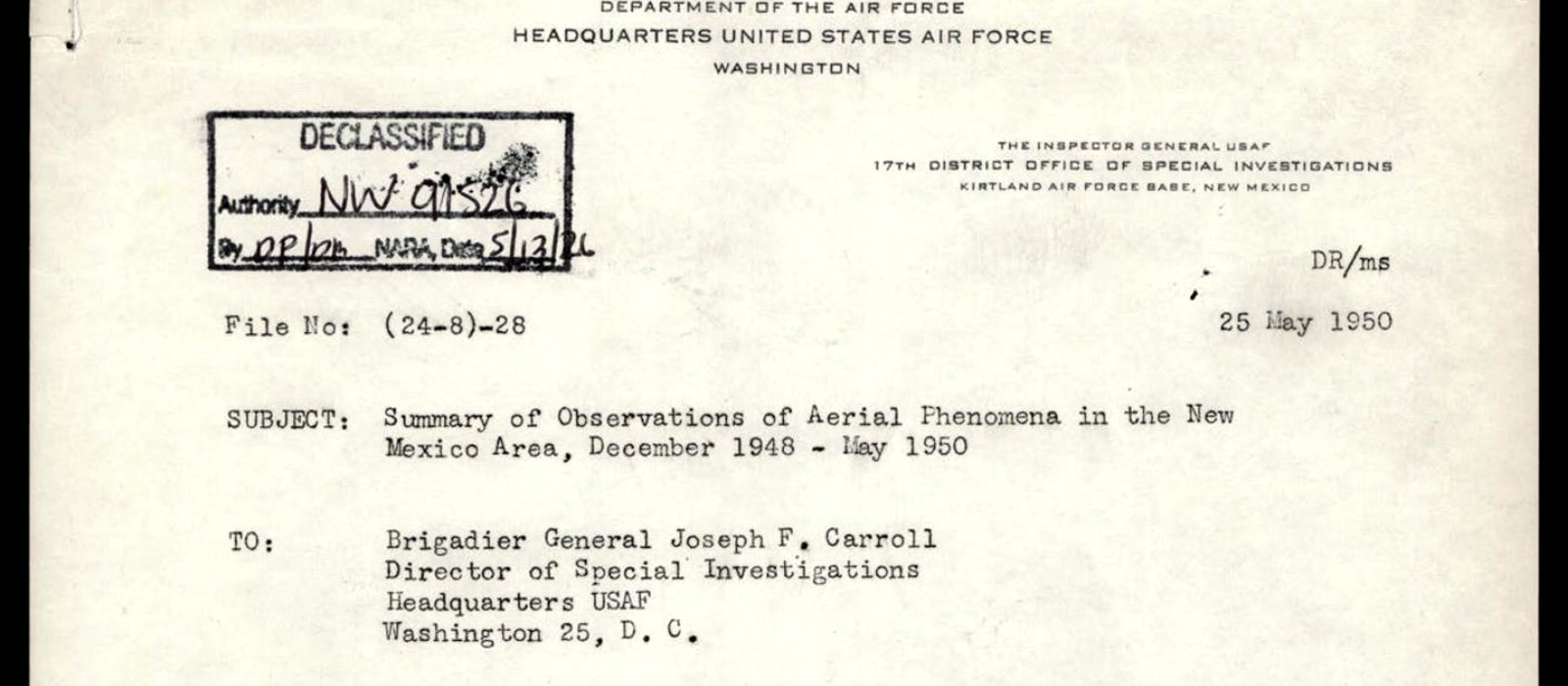
DOW-UAP-D017, “UAP Reported at Sandia Base, 1948-1950” is one of the most valuable documents in War.gov Release 02 because it takes a familiar UFO-era image - strange lights over New Mexico - and places it inside a serious early Cold War record environment. The file points to 209 reports of green orbs, discs, and fireballs near Sandia Base and the broader New Mexico security landscape between 1948 and 1950.
That number is what will travel online. It is dramatic, simple, and easy to turn into a headline.
But the deeper value is elsewhere.
The Sandia file shows a government system trying to sort recurring aerial reports into categories, collect physical traces, consult scientists, involve military and intelligence offices, and decide whether unusual observations near sensitive installations deserved continued study. It does not identify the objects. It does not prove an extraordinary origin. It does not make “unidentified” mean “alien.”
It shows attention.
For historical UAP research, that is already significant.
What DOW-UAP-D017 Is
DOW-UAP-D017 is a historical PDF record released through the Department of War’s PURSUE archive as part of the second public tranche announced on May 22, 2026. The document is not a modern sensor clip like the Lake Huron shootdown video and not a first-person operational narrative like the ODNI orange-orb account.
It is a historical file.
That matters because historical files require a different reading method. They are often composites: correspondence, memoranda, observation summaries, scientific comments, meeting notes, routing stamps, and partial scans from earlier classification systems. They preserve institutional behavior as much as they preserve event claims.
In this case, the record centers on New Mexico aerial phenomena from December 1948 through May 1950. The file includes a May 25, 1950 summary from the 17th District Office of Special Investigations at Kirtland Air Force Base, correspondence connected to Dr. Lincoln LaPaz and other investigators, and discussion of attempts to collect airborne particles after reported fireball events.
That combination makes the file more than a list of sightings.
It is a window into how officials were thinking.
The 209 Reports Are Important, But Not Self-Explaining
The site’s indexed summary of DOW-UAP-D017 notes 209 reported sightings of “green orbs,” “discs,” and “fireballs” near Sandia Base from 1948 to 1950. That is a large cluster. It deserves attention.
It also needs restraint.
A count of reports is not the same as a count of confirmed unknown objects. It may include observations of different quality, different witness reliability, different environmental conditions, different object descriptions, and different levels of follow-up. The 1950 summary itself treated classification as a necessary step. Reports were grouped into categories such as green fireball phenomena, disc-like variations, and probably meteoric events.
That structure is crucial. The file was not simply saying, “209 mysteries happened.” It was trying to sort a field of reports into more useful bins.
That makes DOW-UAP-D017 useful for researchers, but it also protects the file from bad readings. If every report is flattened into proof of one phenomenon, the archive becomes less accurate. If every report is dismissed because some may be meteoric, the archive loses the pattern that made officials pay attention in the first place.
The better reading is narrower: the Sandia file documents a sustained reporting problem around New Mexico skies in the early Cold War, with enough recurrence and enough institutional interest to justify organized collection and scientific consultation.
That is not a final answer.
It is a serious historical starting point.
Why New Mexico Changed The Meaning Of The Reports
New Mexico was not just scenery.
By the late 1940s, New Mexico sat inside a dense national-security geography: Los Alamos, Sandia, Kirtland, military research, weapons work, scientific institutions, proving grounds, and early Cold War anxiety. A strange light over an empty landscape might be a curiosity. Repeated reports near a sensitive security environment became a different kind of problem.
That does not mean the objects were hostile. It does not mean they were secret weapons. It does not mean they were non-human technology.
It means location changed the level of attention.
The 1950 summary says the frequency of unexplained aerial phenomena in the New Mexico area led to an organized plan of reporting beginning in December 1948. It also says reports were distributed through military and intelligence channels. Later in the same summary, the continued occurrence of unexplained phenomena near sensitive military and government installations is treated as a concern.
This is one of the most important lessons of the file. UAP records do not become meaningful only when they contain dramatic imagery. They also become meaningful when they show how institutions reacted to uncertainty near important sites.
The Sandia file therefore belongs beside modern Release 02 material, even though it looks very different. A modern video asks what the sensor captured. A historical New Mexico file asks why a pattern of reports entered official channels and how those channels tried to handle it.
Both questions matter.
LaPaz And The Scientific Caution Inside The File
Dr. Lincoln LaPaz is central to the file’s historical weight.
LaPaz was not a casual commentator. He was associated with the University of New Mexico’s meteorite work and appears in the file as a scientific consultant in connection with green fireball investigations. The point is not that his involvement proves the phenomenon was extraordinary. The point is that the file records scientific engagement with the problem.
The distinction matters.
In several portions of the file, the green fireballs are discussed in relation to meteor behavior. That is exactly what a responsible investigation should do. If the phenomena were fireball-like, meteor science was an obvious place to start. The file considers features such as paths, brightness, color, sound, fragmentation, time distribution, and possible material traces.
At the same time, the record does not present a clean, easy explanation for every report. LaPaz and others treated some characteristics as unusual enough to warrant continued study. The Los Alamos meeting notes show scientists and security officials discussing whether the phenomenon fit ordinary meteor behavior, guided missiles, or other possibilities.
The mature reading is not “LaPaz proved the green fireballs were exotic.”
He did not.
The mature reading is that the file preserves a period when credible officials and scientists were not satisfied with a single lazy explanation. They were trying to decide which reports were probably meteoric, which were poorly understood, and which might require additional collection.
That is the kind of historical nuance UAP archives need more of.
The Dust-Collection Thread Is The Most Interesting Evidence Lead
The most underrated part of DOW-UAP-D017 is not the sighting count. It is the attempt to collect physical material.
The file includes discussion of the July 24, 1949 Socorro fireball and subsequent airborne-particle collection. The document describes impact equipment, timing after the event, copper-bearing particles found in some collections, later collections with far fewer indications, and further discussion of nickel and cobalt tests. A later Socorro sample is described in the site’s indexed key findings as containing many small particles and three apparently spherical particles with strong cobalt indications.
This is exactly where careful readers should lean in - and slow down.
Physical collection is more valuable than rumor. It can move a case from witness description toward testable evidence. But the file itself shows why the step is difficult. Collections happened after time had passed. Wind, particle fall rates, local contamination, building material, roof or gutter dust, equipment limits, and sampling location all become part of the problem. The file’s discussion does not allow a simple public conclusion that copper or cobalt particles came from a green fireball.
In fact, the file contains caution around the association.
That caution is not a weakness. It is one reason the file is useful.
It shows investigators wrestling with exactly the problem modern UAP research still faces: an intriguing trace is not enough unless collection timing, environmental controls, chain of custody, and comparative analysis are strong enough to support the interpretation.
The Sandia file therefore gives today’s archive a good standard. If a future UAP release claims physical material, the public should ask:
- When was the sample collected relative to the event?
- Where exactly was it collected?
- What control samples were taken?
- What ordinary contamination sources were considered?
- Who handled the sample?
- What methods were used to analyze it?
- What conclusion did the investigators actually support?
Those questions are not debunking. They are the difference between evidence and atmosphere.
The Los Alamos Meeting Shows Institutional Seriousness
The Los Alamos meeting notes are another reason this file deserves its own article.
A February 1949 report describes a conference at Los Alamos to discuss the green fireball phenomena. Participants included scientific and military personnel, and the discussion involved Dr. LaPaz, Sandia Base, Air Force representatives, and figures associated with the Los Alamos scientific environment.
Again, the point is not to inflate the meeting into proof of origin.
The point is that the event was not being handled as a campfire story.
The file records a live debate over possible explanations and over the importance of continued investigation. It also shows the language of security concern: unexplained phenomena near sensitive installations were not just strange; they were operationally relevant. During the early Cold War, even ordinary explanations could matter if they revealed gaps in observation, reporting, or airspace awareness.
That frame is still useful now.
Modern UAP discussions often jump too quickly from “unidentified” to “extraordinary.” The Sandia file reminds readers that there is a middle category: unresolved phenomena can be important because of where they occur, who sees them, how often they recur, and what institutions must do in response.
Importance is not the same as exotic origin.
The Sandia file is important even if some reports were meteors, misidentifications, atmospheric events, or wartime-era technological confusion. The official reaction itself is historically valuable.
What The File Does Not Prove
DOW-UAP-D017 does not prove that non-human craft visited New Mexico.
It does not prove that every green fireball was the same object type. It does not prove that copper or cobalt particles came from aerial phenomena. It does not prove that the reports were hostile surveillance. It does not prove that Sandia Base was the target of anything.
It also does not erase ordinary explanations.
Some reports may have been meteors. Some may have been aircraft, balloons, tests, observational errors, atmospheric effects, or reports distorted by memory and local rumor. Historical files often preserve uncertainty, not resolution. The age of a file does not make every claim stronger. A classification stamp does not turn a report into a conclusion.
That is the evidence boundary.
The public record supports a narrower and more defensible claim: by 1950, U.S. military and scientific channels had organized around a recurring New Mexico aerial reporting problem, including green fireball reports near sensitive installations, and had attempted to study parts of the problem through observation summaries, scientific consultation, and physical collection efforts.
That claim is strong enough.
It does not need exaggeration.
Why This Historical File Belongs In Release 02
At first glance, Sandia may seem out of place beside modern military videos, NASA audio, the CIA Soviet report, and the ODNI narrative.
It is not out of place.
Release 02 is most useful when readers stop treating it as one pile of UFO content and start treating it as a mixed evidence archive. A video record, a first-person narrative, a Cold War intelligence report, a NASA audio excerpt, and a Sandia historical file all answer different questions.
The Sandia file answers this one:
How did early national-security institutions handle repeated aerial reports near sensitive places before the modern UAP vocabulary existed?
That question matters because today’s transparency debate is not only about new objects. It is also about continuity. The public wants to know whether government interest in UAP is recent, episodic, political, or historically persistent. DOW-UAP-D017 does not answer the whole question, but it gives one well-preserved data point.
It shows that by the late 1940s, recurring unexplained aerial reports around New Mexico were serious enough to generate summaries, meetings, scientific consultation, and proposed collection methods.
That is why the file matters.
What Future Releases Should Add
The Department of War has said additional PURSUE releases are being prepared. If later releases expand the Sandia record, the most useful additions would not be more dramatic wording. They would be better context.
The public needs:
- A clean index of all 209 sightings with dates, locations, witness categories, and evaluation labels.
- Higher-quality scans or OCR for the tables and handwritten portions.
- A map of sightings in relation to Sandia, Los Alamos, Kirtland, Socorro, Las Vegas, and other referenced locations.
- Any follow-up analysis on the copper, cobalt, nickel, or other particle findings.
- Control-sample data and environmental notes for the Socorro collections.
- Related Project Grudge, OSI, AEC, FBI, Air Force, and university correspondence.
- Any later official conclusion, correction, or closure memo.
Those additions would not automatically prove an extraordinary explanation. They would do something more useful: make the historical cluster easier to test.
That is what a serious public archive should aim for.
The Bottom Line
The Sandia green fireball file is one of the most important records in Release 02 because it shows early official attention to recurring aerial reports near sensitive New Mexico sites.
It is not important because it proves what the objects were.
It is important because it shows how difficult the problem already was by 1950. Officials had reports, witnesses, scientific advisers, security concerns, physical-collection attempts, and competing possible explanations. They also had uncertainty.
That is the honest historical record.
DOW-UAP-D017 should be read as evidence of institutional attention, organized reporting, and unresolved inquiry. It should not be read as public proof of origin. Its value is that it lets us see the government trying to build a method around a confusing pattern.
For UFO Declassified, that is exactly the kind of record worth preserving carefully.
Not every file settles a mystery.
Some files show why the mystery survived.