Colorado Springs UAP: A Low-Confidence Explanation Is Not a Closed Case
The Colorado Springs UAP file is useful because it refuses to become either kind of easy story.
It is not a dramatic alien-reveal story. The public record does not support that. It is also not a clean debunking story. The official explanation is explicitly low confidence. That makes the case one of the more instructive records in War.gov Release 03: it shows how a strange sighting can have a plausible natural explanation and still remain unresolved.
The core record is ICA-UAP-D001, “Analysis Colorado Springs UAP Incident”, released as part of the Department of War’s third PURSUE tranche on June 12, 2026. It should be read beside the FBI interview record FBI-UAP-D001, the forensic sketch interview FBI-UAP-D002, and the official visual rendering FBI-UAP-D003.
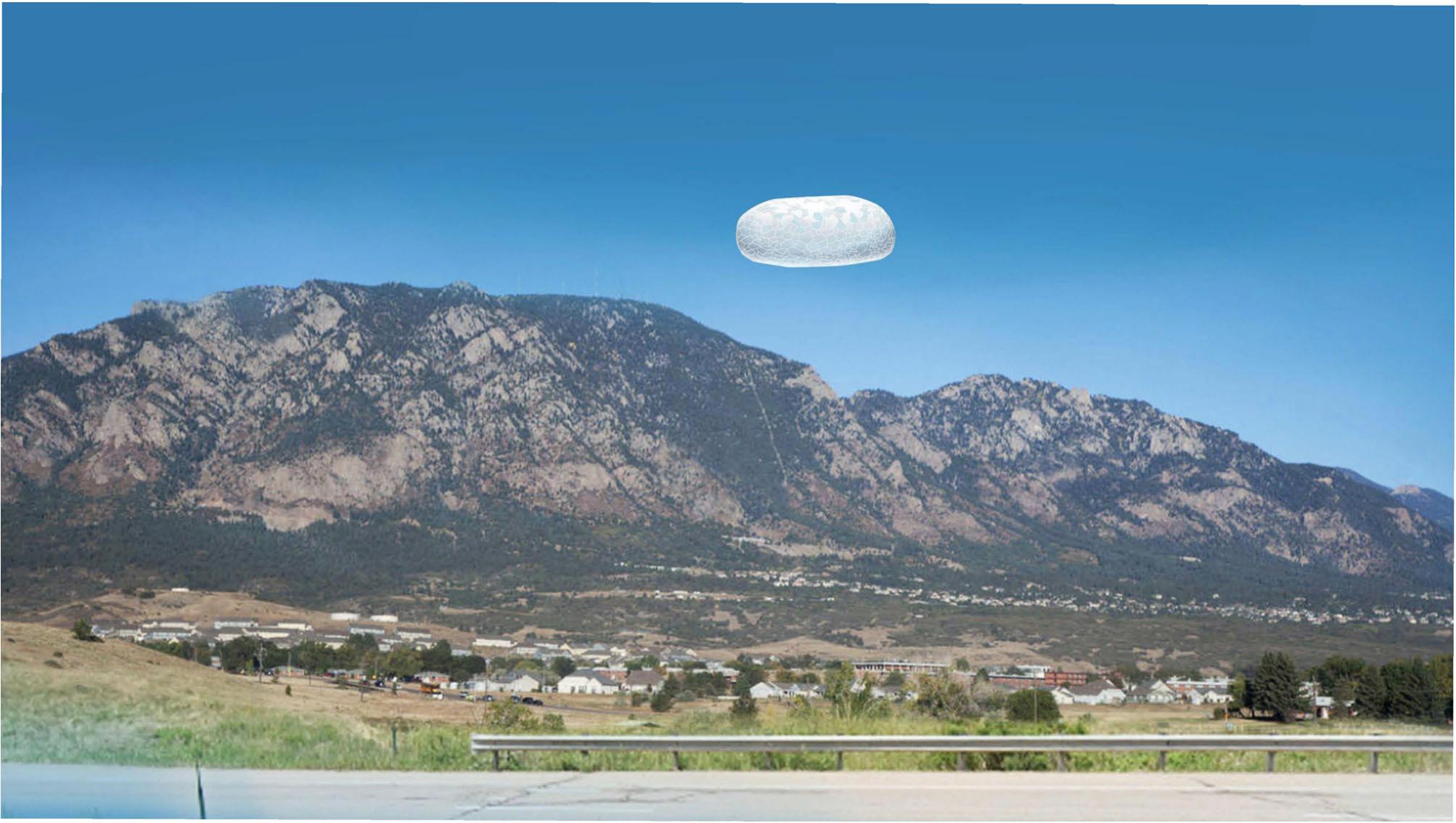
The public case is narrow but interesting. Five U.S. Army service members at Fort Carson reported seeing a pale, stationary, irregular object over or slightly behind Cheyenne Mountain on February 15, 2022. The object was described as bean-shaped or potato-shaped, off-white, non-metallic, slightly translucent, and covered with uneven panel-like markings. It reportedly remained visible for minutes, made no sound, and vanished when the witnesses briefly looked away.
The government analysis says the object was possibly sunlight backscattering from snow-covered ground onto low clouds. That is a real explanation, not a shrug. But the same analysis says confidence is low because the field of view, snow cover, cloud amount, and cloud elevation are uncertain.
That is the point of the file.
Sometimes the most honest public answer is not “solved” or “extraordinary.” Sometimes it is: plausible, incomplete, and still worth preserving.
What The Witnesses Reported
The FBI interview record says the sighting occurred on a workday in early February 2022 at Fort Carson. One witness and four other soldiers had driven to a building and were walking west toward the entrance. Looking west was natural because Cheyenne Mountain was visible.
The group noticed a strange object hovering over a low point or saddle in the mountain. The witness described it as matte white or off-white, non-metallic, oval or bean-shaped, and horizontal. It appeared completely motionless. No sound was heard. All five men reportedly saw it and pointed it out to each other.
The object did not appear to drift in the wind. The witness said they observed it for approximately three to five minutes and that it did not change position relative to the mountain saddle. Its surface was described as having intersecting lines or ridges, forming an abstract polygon pattern over the entire object.
Then came the most ordinary evidence failure in the case: none of the men had a phone on them. The group looked away briefly while deciding whether someone should return to the vehicle to get a phone. When they looked back, the object had vanished.
That missing video matters. Without it, the case rests on witness memory, later drawings, interviews, weather reconstruction, and analysis of possible environmental conditions.
The forensic sketch interview adds detail. In that account, a former U.S. Army intelligence officer said the object was seen at about 11:25 a.m. with four other unit members. The day was described as a “blue bird” sky, with little humidity and a temperature around 50 degrees Fahrenheit. The object was described as potato-shaped with distinct edges, creamy or whitish, opalescent, somewhat translucent, and slightly shimmering. Its surface looked like irregular, non-overlapping fish-scale panels, and the panels appeared to shift in slow waves.
After about two minutes, the object vanished. The witness said it “cloaked” in the time it took to turn a head, with no shadow.
That language is vivid. It is also witness language. The responsible reading is to preserve it without converting it into measured fact.
What The Official Explanation Says
The analysis record offers a possible physical explanation: sunlight reflecting off snow-covered ground near Cheyenne Mountain may have illuminated low-level clouds, creating a visible shape that disappeared when the cloud or sun angle shifted.
This is a sensible hypothesis. The report notes that on February 15, 2022, the sun was in the southeastern sky at a relatively low altitude, casting angled light. Snow depth on Cheyenne Mountain likely ranged from 6 to 12 inches. Some weather sources indicated clouds were present, even though witnesses described clear blue skies. The analysis explains that backscattering can occur when sunlight reflects upward from snow-covered ground, scattering through the atmosphere and illuminating clouds.
That explanation has real strengths.
It can account for a bright, pale, shimmering appearance. It can explain why the object appeared over the mountain. It can explain a sudden disappearance if the light geometry or cloud position changed. It does not require aircraft, balloons, drones, or exotic technology.
The file also says no aircraft or balloons were noted active in or around Cheyenne Mountain during the time the witnesses saw the object. That matters because it narrows one set of ordinary explanations without forcing an extraordinary one.
But the explanation does not close the case.
The record says confidence is low. It cites uncertainty in each witness’s field of view, the amount of snow cover, the exact elevation of cloud cover, and the amount of cloud cover. It also says no anomalous data or characteristics were recorded or assessed, and that the event did not represent an unknown adversarial capability.
That combination is important. The government is not saying, “We know exactly what it was.” It is saying, in effect: the best available explanation may be sunlight backscatter, but the record is too incomplete to state that with high confidence.
That is not a weakness in the file. It is an honest label.
Why “Low Confidence” Matters
Low confidence is not a decoration. It is the most useful phrase in the Colorado Springs case.
Public UFO debates often turn every official explanation into one of two things. Believers may treat a conventional explanation as a cover story. Skeptics may treat a plausible explanation as final closure. The Colorado Springs file resists both habits.
A low-confidence explanation means an analyst has a candidate explanation but not enough certainty to close the case strongly. It means the explanation fits some features but depends on assumptions that are not fully pinned down. It means the available evidence does not justify a more confident claim.
That is exactly where many UAP records live.
For Colorado Springs, the backscatter hypothesis fits the pale, shimmering, stationary appearance and the sudden disappearance. But it depends on cloud conditions, snow cover, viewing angle, the sun’s position, and how accurately the witnesses remembered where the object appeared relative to the mountain.
The witness reports also add tension. Five people reportedly saw the object. The surface pattern was remembered consistently enough that the group later compared drawings. The object was described as having defined edges and a panel-like texture. It was remembered as stationary, not slowly drifting like a cloud. Those details do not disprove the backscatter explanation, but they are exactly why the confidence is not high.
The case is not extraordinary because it remains unresolved. It is important because the unresolved status is bounded.
The public record supports a narrower claim: five Army witnesses reported a strange stationary pale object over Cheyenne Mountain, and an official analysis found a plausible low-confidence natural explanation while leaving uncertainty in place.
That is enough for a serious article.
It is not enough for a final verdict.
The Rendering Helps, But It Can Mislead
The official rendering in FBI-UAP-D003 makes the case easier to understand. It shows a pale, irregular, rounded object above a mountain skyline. For readers, that image is immediately more memorable than the text.
But it should not be treated as a photograph.
The rendering is a visual recreation based on witness description and the forensic sketch process. It is useful for communicating shape, color, and approximate visual impression. It is not a sensor record. It is not a frame from the day of the event. It does not verify altitude, distance, size, cloud height, or exact lighting.
That distinction matters because the Colorado Springs image is easy to overread. The object looks tangible in the rendering. It has edges. It has a surface. It looks like something suspended in front of a blue sky. But the analysis record is specifically asking whether an illuminated cloud feature could have been perceived as a defined object.
The visual recreation helps readers understand the witness memory. It does not settle whether that memory was produced by an object, a cloud-light effect, or another source.
This is why UFO Declassified should treat official renderings as interpretation aids, not primary evidence.
What The Media Saw In The Case
The Associated Press noticed the Colorado Springs case because the description is memorable: an object compared to a potato or bean, with a shimmering, fish-scale-like appearance. That is exactly the kind of detail that makes a government file travel beyond the archive.
The Guardian included the case in a broader skeptical frame: the latest files contain strange lights and vivid accounts, but few hard facts and no conclusive evidence of extraterrestrial life. Its summary also captured the central tension in this record: AARO proposed sunlight reflecting from snow-covered mountains onto clouds, but labeled the assessment low confidence and left the incident unresolved.
Both framings are useful as long as the article does not stop there.
The news hook is the “potato” object. The research value is the low-confidence explanation.
That distinction is the difference between a viral oddity and a useful source page.
What The Case Adds To Release 03
Colorado Springs plays a different role from the Western U.S. orbs case.
The Western U.S. event is a complex multi-witness narrative with partial conventional explanation and a remaining unresolved share. Colorado Springs is quieter: one daytime sighting, five witnesses, no phone capture, a later forensic sketch, and an environmental hypothesis.
That quietness is valuable.
It gives readers a clean example of how a case can move through layers:
- A group observes something unusual.
- The group compares memory and sketches.
- The event is reported through official channels.
- The FBI records an interview and sketch process.
- An intelligence assessment proposes a possible natural explanation.
- The confidence level remains low because the source data is incomplete.
That path is exactly what a public UAP archive should reveal. It is not just about the strange thing in the sky. It is about what happens after the sighting becomes a record.
Colorado Springs also helps protect the archive from two bad habits. The first is sensationalism: treating every vivid description as evidence of exotic origin. The second is premature closure: treating every possible explanation as a solved case.
The file argues for a third approach: preserve the report, test ordinary explanations, label confidence honestly, and keep the evidentiary limits visible.
What Future Records Should Add
The most useful future material would not be a sharper rendering. It would be a reconstruction.
For the Colorado Springs case, a stronger public record would include:
- A redacted but precise observation point or range of possible witness positions.
- The estimated direction of view for all five witnesses.
- Weather records from the closest reliable stations, including cloud type, cloud height, and cloud movement.
- Snow-cover data for the visible slopes of Cheyenne Mountain on February 15, 2022.
- A solar-angle diagram showing whether reflected sunlight could illuminate cloud features along the reported sight line.
- Any building, camera, traffic, security, or base sensor footage from the relevant time window.
- The original witness sketches, with redactions if needed.
- A short explanation of why aircraft, balloons, and adversarial systems were excluded.
Those additions might strengthen the snow-backscatter explanation. They might weaken it. Either outcome would improve the public record.
The goal is not to keep the case mysterious. The goal is to make the confidence label earned.
Bottom Line
The Colorado Springs UAP file matters because it shows a responsible middle category: a plausible explanation that does not fully close the case.
The witnesses described a stationary, pale, bean- or potato-shaped object above Cheyenne Mountain. The FBI records preserve the witness account and sketch process. The official analysis offers a possible natural mechanism: sunlight reflected from snow-covered ground illuminating low-level clouds. But that same analysis labels the assessment low confidence because the viewing geometry and weather details are uncertain.
That is the most careful conclusion available from the public record.
The Colorado Springs case is not proof of alien technology. It is not a settled misidentification. It is a small but useful example of how UAP evidence should be handled when the story is vivid, the explanation is plausible, and the data is incomplete.
Start with ICA-UAP-D001, the Colorado Springs analysis, then compare the FBI interview record, the forensic sketch interview, and the official rendering.