Every NASA Apollo UFO Photo Just Declassified — Full Analysis
When the PURSUE initiative released its first batch of 162 declassified files on May 8, 2026, the NASA contribution immediately caught global attention. Twelve files spanning the Apollo and Gemini programs — including six high-resolution images from the lunar surface — were made publicly available for the first time.
This article examines each NASA file in detail, placing them within their mission context and analyzing what they reveal.
The NASA Files at a Glance
| # | File ID | Mission | Type | Year |
|---|---|---|---|---|
| 1 | NASA-UAP-D1 | Apollo 12 | Communications Transcript | 1969 |
| 2 | NASA-UAP-D2 | Apollo 17 | Communications Transcript | 1972 |
| 3 | NASA-UAP-D4 | Apollo 11 | Technical Crew Debriefing | 1969 |
| 4 | NASA-UAP-D5 | Apollo 17 | Crew Debriefing for Science | 1973 |
| 5 | NASA-UAP-D6 | Apollo 17 | Technical Crew Debriefing | 1973 |
| 6 | NASA-UAP-D7 | Skylab | Technical Crew Debriefing | 1973 |
| 7-12 | NASA-UAP-VM1–VM6 | Apollo 12 & 17 | Visual Media | 1969, 1972 |
Notice the gap in numbering — there is no NASA-UAP-D3 in this release. Whether this indicates a withheld document or simply a cataloging decision by the PURSUE team remains unclear.
Apollo 12: The Lunar Surface Anomalies
Mission Context
Apollo 12 launched on November 14, 1969, just four months after the historic Apollo 11 landing. Astronauts Charles “Pete” Conrad Jr. and Alan L. Bean descended to the Ocean of Storms while Richard F. Gordon Jr. orbited in the Command Module.
The mission achieved the first precision lunar landing, touching down within walking distance of the Surveyor 3 probe that had landed two years earlier. The crew conducted two EVAs (Extravehicular Activities) totaling nearly 8 hours on the lunar surface.
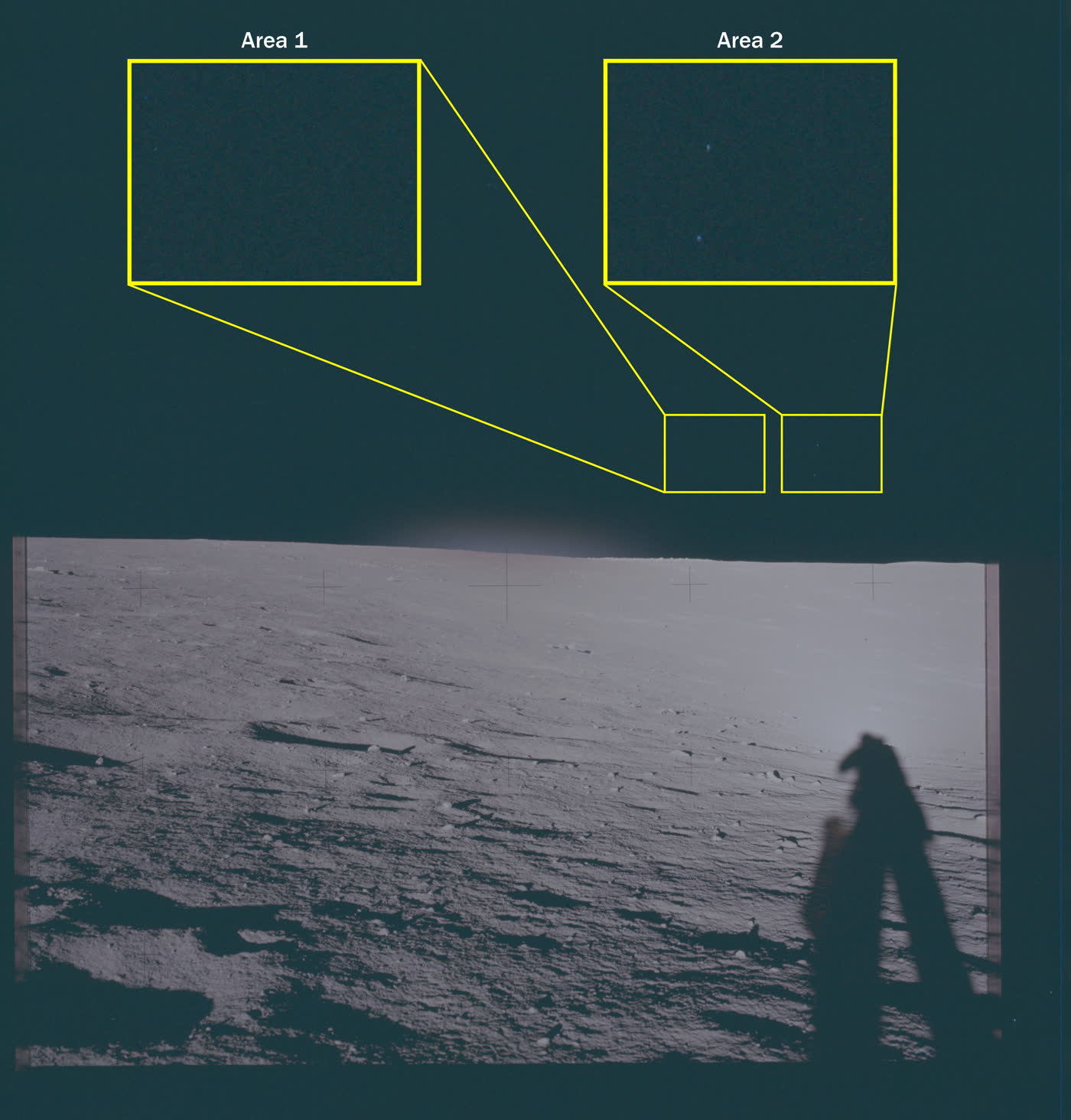
The Six Visual Media Files (VM1–VM5, VM6)
Five of the six released images (VM1 through VM5) originate from Apollo 12 in 1969. Each file is notably large — between 2.3 and 2.5 MB — indicating high-resolution scans of original film.
These are not casual snapshots. Apollo astronauts used modified Hasselblad 500EL cameras loaded with specially manufactured Kodak Ektachrome film. Every frame was carefully composed and documented in detailed photographic logs.
What the images show:
The Apollo 12 visual media files depict the lunar surface as photographed during EVA activities. What makes them significant is that they were selected for inclusion in a UAP-focused declassification release — suggesting the reviewing authorities identified anomalous features within them.
Possible anomalies that could warrant their inclusion:
- Unusual light artifacts not consistent with known camera phenomena
- Unexplained objects or shadows in the lunar landscape
- Optical anomalies in the lunar sky (which should appear completely black in vacuum)
- Surface features that don’t match expected geological formations
Without official analysis notes (which may exist in unreleased portions of the file), we can only note that NASA and the PURSUE review board determined these images met the threshold for UAP-related disclosure.
The Apollo 12 Communications Transcript (D1)
File: NASA-UAP-D1 — Apollo 12 Communications Transcript, 1969
This document records voice communications between the Apollo 12 crew and Mission Control in Houston. Communications transcripts from Apollo missions were meticulously maintained, capturing every exchange between astronauts and ground personnel.
The inclusion of this particular transcript in a UAP release suggests it contains dialogue referencing unidentified objects or unexplained phenomena observed by the crew. During the Apollo era, astronauts communicated on multiple channels — some recorded and publicly available, others on private loops intended for mission-critical communications only.
Read the Apollo 12 transcript →
Apollo 11: The First Lunar Landing
Technical Crew Debriefing (D4)
File: NASA-UAP-D4 — Apollo 11 Technical Crew Debriefing, 1969
The Apollo 11 crew — Neil Armstrong, Buzz Aldrin, and Michael Collins — underwent extensive debriefing sessions after their return to Earth on July 24, 1969. These sessions were conducted while memories were fresh and covered every aspect of the mission.
Technical crew debriefings followed a structured format, systematically reviewing each mission phase: launch, translunar injection, lunar orbit insertion, descent, surface operations, ascent, rendezvous, trans-Earth injection, and re-entry. Crew members were encouraged to report anything unusual or unexpected.
Buzz Aldrin has publicly discussed observing a light that appeared to follow the spacecraft during the translunar coast phase. In a 2005 interview, he described seeing “a light out the window that appeared to be moving alongside us.” The crew initially considered it might be the S-IVB (the rocket’s upper stage), but calculations showed the S-IVB was approximately 6,000 miles away at the time.
This debriefing document may contain the official, contemporaneous account of that observation — recorded days after the mission rather than decades later in interviews.
Read the Apollo 11 debriefing →
Apollo 17: The Final Lunar Mission
Apollo 17, launched December 7, 1972, was the last crewed mission to the Moon. Commander Eugene Cernan, Lunar Module Pilot Harrison Schmitt (the only professional geologist to walk on the Moon), and Command Module Pilot Ronald Evans spent over 12 days in space, including three days on the lunar surface.
Three documents from Apollo 17 appear in the PURSUE release:
Communications Transcript (D2)
File: NASA-UAP-D2 — Apollo 17 Communications Transcript, 1972
Similar to the Apollo 12 transcript, this records voice communications during the mission. Apollo 17 was notable for several unusual observations reported by the crew, including what Cernan described as “bright flashes” on the lunar surface — a phenomenon later investigated as possible cosmic ray interactions with the retina, but never fully explained for all reported instances.
Read the Apollo 17 transcript →
Visual Media (VM6)
File: NASA-UAP-VM6 — Apollo 17 Visual Media, 1972
The sixth and final visual media file comes from Apollo 17 rather than Apollo 12. At 1.7 MB, it is somewhat smaller than the Apollo 12 images but still represents a high-resolution scan.
Apollo 17 astronauts took over 2,200 photographs during their mission — more than any other Apollo crew. The selection of this particular image for the UAP release implies it captured something the review board considered anomalous.
Crew Debriefings (D5, D6)
File: NASA-UAP-D5 — Apollo 17 Crew Debriefing for Science, 1973 File: NASA-UAP-D6 — Apollo 17 Technical Crew Debriefing, 1973
Apollo 17 uniquely produced two separate debriefing documents. The “for Science” debriefing (D5) focused on scientific observations, while the “Technical” debriefing (D6) covered operational and engineering aspects.
The existence of both debriefings in the PURSUE release suggests that UAP-related observations were discussed in both scientific and technical contexts — indicating the crew reported phenomena that had both scientific significance and operational implications.
Harrison Schmitt, as a trained geologist, would have been particularly qualified to distinguish between known geological or optical phenomena and genuinely anomalous observations. His scientific observations carry significant weight in any analysis.
Read the technical debriefing →
Skylab: America’s First Space Station
Technical Crew Debriefing (D7)
File: NASA-UAP-D7 — Skylab Technical Crew Debriefing, 1973
Skylab, launched in May 1973, was crewed by three successive teams over a period of 171 days. The included debriefing does not specify which crew mission it relates to:
- Skylab 2 (May–June 1973): Conrad, Kerwin, Weitz — 28 days
- Skylab 3 (July–September 1973): Bean, Garriott, Lousma — 59 days
- Skylab 4 (November 1973–February 1974): Carr, Gibson, Pogue — 84 days
Skylab orbited at approximately 270 miles altitude — significantly lower than the Moon but much higher than the International Space Station’s current orbit. This altitude provided a unique observational vantage point.
The Skylab crews conducted extensive Earth observation experiments and photographed numerous atmospheric and oceanic phenomena. Any anomalous observations from this orbital platform would be particularly significant because:
- The crew had extended time to observe and document phenomena (unlike brief Apollo transits)
- Multiple crew members could simultaneously verify observations
- Scientific instruments aboard could potentially record phenomena
- The station’s orientation could be adjusted for better observation
Gemini 12: The Earliest Record
Audio Recording (1965)
File: NASA-UAP-Audio — December 5, 1965, Low Earth Orbit
This is the oldest NASA file in the PURSUE release and one of the earliest space-based UAP records ever declassified. Gemini 12 was the final mission of the Gemini program, crewed by James Lovell (who would later command the famous Apollo 13 mission) and Buzz Aldrin.
The mission launched on November 11, 1966. However, the audio file is dated December 5, 1965 — which predates Gemini 12’s actual launch by nearly a year. This dating discrepancy may indicate:
- The file relates to a different Gemini mission
- A cataloging error in the PURSUE system
- Pre-mission audio from training or simulation
The audio format itself is significant. In the Gemini era, voice communications were recorded on analog tapes. The fact that this recording survived and was identified for UAP-related disclosure suggests it contains content that reviewers in 2026 considered relevant.
What the NASA Files Tell Us
Pattern Analysis
Several patterns emerge from examining the NASA contribution as a whole:
1. Focus on the Apollo Era Ten of twelve files come from the Apollo program (1969–1973). This concentration suggests either:
- Apollo crews encountered more anomalous phenomena than other programs
- Apollo-era records were more thoroughly reviewed
- The review board prioritized the most historically significant missions
2. Debriefings Over Raw Data The emphasis on crew debriefings rather than instrument data suggests that human observation — astronaut testimony — is considered the primary evidence. These were test pilots and scientists trained to observe and report with precision.
3. Visual Evidence Six high-resolution images were included, all from the lunar vicinity. No images from Earth orbit or deep space were released, suggesting the anomalies are specifically associated with the Moon or cislunar space.
4. Multi-Mission Correlation By including files from Apollo 11, 12, and 17 (spanning 1969–1972), the release implicitly suggests that anomalous observations were not isolated to a single mission but recurred across multiple crews and time periods.
Historical Significance
These twelve files represent the first time NASA has officially contributed to a UAP-focused disclosure effort. While individual astronaut statements about UFO sightings have circulated for decades, the institutional release of debriefings and visual media through PURSUE marks a fundamental shift.
NASA’s inclusion acknowledges, at minimum, that:
- Astronauts reported observations they could not explain
- These observations were documented through official channels
- The agency considers these records relevant to the UAP discussion
- The evidence warrants public examination
Explore the Full NASA Collection
All twelve NASA files are available in our archive:
- Apollo 11 Technical Crew Debriefing (1969)
- Apollo 12 Communications Transcript (1969)
- Apollo 12 Visual Media (6 images)
- Apollo 17 Communications Transcript (1972)
- Apollo 17 Visual Media
- Apollo 17 Science Debriefing (1973)
- Apollo 17 Technical Debriefing (1973)
- Skylab Technical Debriefing (1973)
- Gemini Audio Recording (1965)
Browse the full archive by visiting our NASA agency page →
This analysis is based on publicly available PURSUE files and historical mission records. Updated as new information becomes available. Last updated: May 10, 2026.