The most useful number in the history of official UFO investigation is not the number of cases closed.
It is the number that stayed open.
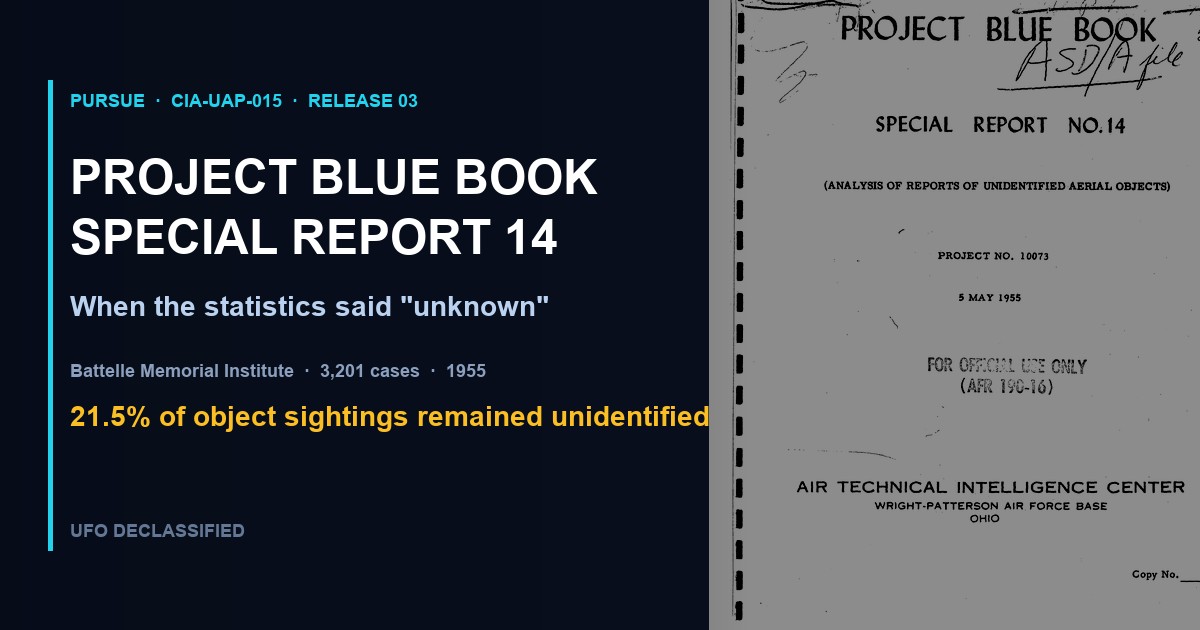
Project Blue Book Special Report No. 14 — titled Analysis of Reports of Unidentified Aerial Objects and dated 5 May 1955 — is the Air Force’s large-scale statistical treatment of early flying-disc reports. The work was done for the Air Technical Intelligence Center (ATIC) at Wright-Patterson Air Force Base. The contractor is almost always named in the secondary literature as the Battelle Memorial Institute. The PURSUE archive indexes the full scanned report as CIA-UAP-015, released in the June 12, 2026 third tranche.
For seventy years the public story of Project Blue Book has been compressed into a slogan: almost everything was identified; the residue was noise. Special Report 14 is the document people cite when they want that slogan to sound scientific. It is also the document that undercuts the slogan if you read the tables instead of the press summary.
This article is a data walkthrough of that report: what was measured, what “unknown” meant, what the headline percentages actually were, and what the Air Force public line did with those numbers.
What Is Project Blue Book Special Report 14?
Project Blue Book Special Report 14 is not a single famous sighting file. It is a methodology document.
The report’s own framing is plain. From mid-1947, the Air Force had received reports of “unidentified aerial objects” (the popular terms in the text are “flying saucers” or “flying discs”). There was, the Summary says, “no evidence that the unexplained reports of unidentified objects constituted a threat to the security of the U.S.” The study still had a concrete purpose: investigate whether the reports pointed to “technological developments not known to this country,” and whether any trend or pattern could be extracted from the raw case pile.
To do that, the authors reduced thousands of narrative reports into standardized abstracts on IBM punched cards. They coded color, shape, speed, duration, brightness, location, observer type, and other fields. They then applied frequency tables, percentage distributions, and chi-square tests comparing KNOWN cases to UNKNOWN cases.
That is why the report still matters in 2026. It is one of the few official UFO products that behaves like a dataset paper rather than a press release. The PURSUE PDF is large — on the order of three hundred pages once you include the appendices of tabulations — because the tables are the product.
If you want the official source path, start here:
- Local archive page: CIA-UAP-015 — Project Blue Book Special Report No. 14
- Official portal: War.gov/UFO
- Institutional neighbors in the same release: the CIA Robertson Panel file and, from Release 04, the 1966 Air Force committee review of Blue Book
The Core Sample: 3,201 Cases Through the End of 1952
The Summary is explicit about the cut-off.
The special study “started in 1953.” To give the group a complete file set, “the information cut-off date was established as of the end of 1952.” All charts and tables in the body of the statistical study terminate with that year. In those charts, 3,201 cases have been used.
The report further distinguishes counting units:
| Counting unit | N in the main charts |
|---|---|
| All sightings | 3,201 = 100% |
| Unit sightings | 2,554 = 100% |
| Object sightings | 2,199 = 100% |
The distinction matters because one “sighting event” can involve multiple observers or multiple objects. When people quote a single “Blue Book unknown percentage” without saying which base they used, they are already losing precision the original study tried to keep.
For the object-sighting base — the cleanest unit for “what was seen” — the evaluation distribution chart in the report marks 474 = 21.5%. That figure is the one researchers usually mean when they say roughly 22% of the Special Report 14 object cases remained unknown.
So the first correction to the folklore is simple:
In the Special Report 14 core sample, about one in five object sightings stayed in the UNKNOWN bin after evaluation. That is not a rounding error. It is the center of the study.
What “Unknown” Meant in Project Blue Book Statistics
Special Report 14 is careful about labels. The coding system is not a binary of “real saucer” versus “not real saucer.”
The main identification categories include balloons, aircraft, astronomical objects, other conventional explanations, psychological manifestations, insufficient information, and unknown.
Two distinctions in the methodology are easy to miss and hard to overstate:
1. Insufficient Information is not Unknown
INSUFFICIENT INFORMATION was assigned when too much data was missing, or when remaining data were so doubtful that the case could not be identified as a common object or natural phenomenon. The report emphasizes that this bin was not a dump for “poor unknowns.” It was for reports that might have been several different ordinary things if better data had existed.
UNKNOWN was assigned when the description of the object and its maneuvers could not be fitted to the pattern of any known object or phenomenon.
That is a high bar. An unknown in this system is not “we did not bother.” It is “after the coding rules, this still does not match the known patterns.”
2. Certain vs. Doubtful among the knowns
For every identification except insufficient-information and unknown, evaluators could mark Certain or Doubtful. The rule of thumb in the report:
- Certain: better than 95% confidence the identification is correct
- Doubtful: better than even chance, but less positive
When the study later talks about “knowns,” it is including both certain and doubtful conventional explanations. A large share of the “solved” column is not courtroom proof. It is best-available conventional fit.
Final unknowns required a group decision. If evaluators disagreed after conference and consultant review, the case stayed unknown. That process detail matters for anyone who treats the unknown rate as a soft category that could have been massaged away quietly. The written procedure pushes the other way: disagreement defaults toward unknown, not toward forced identification.
Project Blue Book Special Report 14 Statistics That Actually Matter
The public conversation usually stops at “about 22% unknown.” The report is more interesting once you stay with the tables.
Overall evaluation mix
On the object-sighting base of 2,199 cases through 1952, the unknown share is about 21.5%. Secondary syntheses of the same study commonly round the known/identified and insufficient-information remainder roughly as follows:
- Roughly two-thirds identified or provisionally identified as ordinary phenomena (aircraft, balloons, astronomical, other)
- A non-trivial insufficient-information remainder
- About one-fifth unknown
The exact pie slices depend on whether you count certain vs. doubtful knowns and which sighting unit you use. The report itself is built to force that nuance. A one-line press summary cannot.
Later-year trend lines the Summary highlights
Because the study kept comparing post-1952 intake while writing, the Summary also reports later evaluation mixes:
1953–1954 reports (854 cases evaluated on the same basis):
| Category | Share |
|---|---|
| Balloons | 16% |
| Aircraft | 20% |
| Astronomical | 25% |
| Other | 13% |
| Insufficient information | 17% |
| Unknown | 9% |
1 January 1955 – 5 May 1955 (131 reports), after AF Regulation 200-2 and 4602d AISS field investigation:
| Category | Share |
|---|---|
| Balloons | 26% |
| Aircraft | 21% |
| Astronomical | 23% |
| Other | 20% |
| Insufficient information | 7% |
| Unknown | 3% |
Those later numbers are real, and they are also easy to misuse. They measure a different operational regime: faster on-site investigation, a dedicated Air Defense Command squadron, and a smaller recent sample. They do not rewrite the 1947–1952 core tables that contain the famous 21.5% unknown rate.
If someone tells you “Blue Book proved only 3% were unknown,” ask which years, which intake process, and whether they are talking about Special Report 14’s primary sample or the early-1955 snapshot in the Summary.
The quality gradient: better reports, more unknowns
The study stratified sightings into reliability groups — commonly summarized in the secondary literature as Excellent / Good / Doubtful / Poor — based on observer reliability and report completeness.
The result that made the report famous among researchers is not the overall unknown rate. It is the direction of the quality gradient:
As report quality improves, the share of unknowns does not collapse. In the widely cited reading of the reliability tables, excellent cases were substantially more likely to be unknown than poor cases.
That finding is the opposite of the usual debunking expectation. If unknowns were mostly bad data, better data should dissolve them. In Special Report 14, better data often left a larger residual.
You do not need an extraordinary interpretation to find that important. It is a statement about residual structure in the official dataset. The cases that survive ordinary identification are disproportionately the ones with more complete observational detail.
This is also why the report remains relevant next to modern UAP products. When a 2020s military video arrives as a short public rendition with missing metadata, Special Report 14 is a reminder that official systems have always known the difference between a thin report and a strong one — and that strong ones are not automatically the easiest to close.
What the Battelle Study Said It Concluded
The Summary’s bottom line is not ambiguous.
After re-examining the unknowns, the authors conclude that the probability any of them represented “technological developments not known to this country” was “very small.” They write that it is “highly improbable” the reports examined represent observations of technology outside present-day scientific knowledge. They emphasize a “complete lack of any valid evidence of physical matter” in any reported unidentified aerial object case in the study.
They also make a methodological confession that is more honest than most later retellings:
The conclusions “are based NOT on facts, but on what many observers thought and estimated the true facts to be.”
That sentence should be printed on every share card that quotes the 3% figure. Special Report 14 is a statistical analysis of subjective observational reports, not a laboratory paper on recovered hardware. The authors say so.
There is a second tension inside the official language. The Summary says it is “believed that all the unidentified aerial objects could have been explained if more complete observational data had been available.” That is a counterfactual. It is not the same claim as “they were explained.” It is closer to: given perfect data, we expect the residual would vanish.
Expectation is not identification. The residual in the 1947–1952 tables is still a residual.
How the Air Force Public Line Used Project Blue Book Special Report 14
When Special Report 14 entered public discussion in October 1955, the institutional use of the study often outran the tables.
The Air Force needed a scientific-sounding closure narrative after years of saucer headlines. A thick statistical report from a serious contractor was perfect for that purpose. The message that traveled was: careful analysis shows almost nothing anomalous; improved investigation will drive unknowns toward zero; there is no threat and no exotic technology.
Three distortions show up again and again in the later literature:
- Collapsing the sample years. Using the early-1955 3% unknown snapshot as if it described the entire Blue Book era.
- Collapsing insufficient information into identified. Treating every non-unknown as a solid conventional solution.
- Ignoring the quality gradient. Celebrating the decline in unknowns under better field procedures without acknowledging that the best early cases were the hardest to close.
None of those distortions require a conspiracy theory. Bureaucracies summarize complex reports for press officers. Special Report 14 is long, technical, and full of caveats. Press lines prefer short, calm numbers.
The research use of the document runs the other direction. For historians and analysts, the value is precisely that the study coded quality, forced group decisions on unknowns, and left a measurable residual that correlated with report strength.
Reading Special Report 14 Next to the Robertson Panel
Special Report 14 did not appear in a vacuum.
In January 1953 — while the Battelle statistical work was underway — the CIA convened the Scientific Advisory Panel on Unidentified Flying Objects, better known as the Robertson Panel. The panel reviewed a tiny slice of cases, concluded UFOs were not a direct national-security threat, and recommended stripping the subject of its “aura of mystery.”
The chronological relationship is important:
- Robertson (January 1953): policy and perception management after the 1952 Washington wave
- Special Report 14 work (from 1953, data through 1952, report dated May 1955): large-N statistical treatment of the early case set
- Later Blue Book wind-down machinery, including the 1966–1967 Air Force review that helped lead toward the Condon study and program closure
Robertson is a judgment by five scientists over a few days. Special Report 14 is a multi-year coding and testing project on thousands of reports. They answer different questions. Robertson asks whether the subject deserves public scientific prestige. Special Report 14 asks whether the existing report pile contains statistical structure.
If you read only Robertson, you get a recommendation to cool public interest. If you read only the Air Force press gloss of Special Report 14, you get a claim that science closed the case. If you read the actual Special Report 14 tables, you get something harder: a substantial unknown residual, a quality gradient that does not flatter the “bad data” theory, and an official conclusion that still declines to treat that residual as exotic technology.
Those three layers should not be merged into one sentence.
What Special Report 14 Adds to the PURSUE Archive
In the PURSUE Release 03 environment, CIA-UAP-015 is not just historical color. It is infrastructure.
What it adds
- A primary statistical source for early U.S. official UFO analysis, not a later secondary paraphrase.
- Explicit coding rules for known, unknown, and insufficient information — useful whenever modern debates collapse those labels.
- A quality-aware residual. The reliability-group design is the intellectual ancestor of every serious later attempt to separate thin reports from strong ones.
- A bridge between 1950s Air Force process and 2026 public files. Readers can move from Special Report 14 to FBI flying-disc records, Sandia green fireball attention, modern military video cases, and the archive statistics tools without changing evidentiary standards midstream.
- A citation-ready artifact. The report has a date, a project number (10073), an issuing center (ATIC), and a stable PURSUE record page.
What it does not add
- Proof of non-human technology. The report itself rejects that reading.
- Proof that every unknown was ordinary. The residual exists inside the official coding system.
- A complete Blue Book history through 1969. The core tables stop at the end of 1952; later figures in the Summary are comparative snapshots.
- Raw case-level public data for all 3,201 punched cards. You get the study report and appendices, not a modern CSV of every coded field for every case.
- Sensor-native evidence. This is a report-of-reports study. It is not radar tapes, gun-camera originals, or physical samples.
For evidence labeling on this site, Special Report 14 behaves like a historical-archival record with official analysis on record. It is not a modern mission video. It is also not folklore. It is the government arguing with its own spreadsheet.
How to Use Project Blue Book Special Report 14 as a Researcher
If you are not going to read all 300 pages, use this order:
- Summary (front matter). Get the purpose, the 3,201-case cut-off, the later-year comparison tables, and the final improbability language.
- Identification methodology. Learn the difference between unknown and insufficient information, and the certain/doubtful rule.
- Evaluation distribution charts. Lock the ~21.5% object-sighting unknown figure to a specific base.
- Reliability-group figures. This is where the quality gradient lives.
- Chi-square sections. The study tests whether knowns and unknowns look statistically similar on color, number, shape, duration, speed, and brightness. The authors report that apparent similarities do not survive as strong significant matches.
- Conclusions. Separate what was measured from what was inferred about foreign technology and physical matter.
Then place the document in a cluster, not alone:
- Robertson Panel analysis
- FBI flying disc files
- Sandia green fireballs
- PURSUE Release 03 guide
- Evidence Explorer and Archive Statistics
The cluster is the point. Special Report 14 is a method document. Method documents only become powerful when you compare them to the case files they claim to summarize.
FAQ: Project Blue Book Special Report 14
What is Project Blue Book Special Report 14?
It is the May 5, 1955 Air Force / ATIC statistical study Analysis of Reports of Unidentified Aerial Objects, based on coded UFO reports through the end of 1952. It is widely associated with work by the Battelle Memorial Institute and is indexed in PURSUE as CIA-UAP-015.
How many cases did Special Report 14 analyze?
The main charts use 3,201 cases with a data cut-off at the end of 1952. Object sightings in those charts total 2,199.
What percentage of Project Blue Book Special Report 14 cases were unknown?
On the object-sighting base, the report’s evaluation chart marks 474 cases, or 21.5%, as unknown. Secondary discussions often round this to about 22%. Later Summary snapshots show lower unknown rates (about 9% for 1953–1954 evaluations and 3% for early 1955 under revised field investigation), but those are different samples and processes.
Did better evidence reduce unknowns?
Not in the way the simple story expects. Special Report 14’s reliability stratification is famous because higher-quality reports did not cleanly eliminate the unknown residual. The residual is concentrated where the paperwork is stronger, not only where it is weakest.
Did Special Report 14 prove UFOs are extraterrestrial?
No. The report concludes it is highly improbable that the examined reports represent technology outside then-current scientific knowledge, and it notes no valid physical-matter evidence in the study set. The statistical residual is real; the exotic interpretation is not established by this document.
Where can I read the original Project Blue Book Special Report 14 PDF?
Start with the UFO Declassified record page for CIA-UAP-015, which points to the PURSUE / War.gov public release path.
Bottom Line
Project Blue Book Special Report 14 is the rare official UFO document that rewards a spreadsheet brain.
It coded thousands of early reports. It defined “unknown” narrowly. It found roughly one in five object sightings still unexplained in the 1947–1952 core sample. It built a quality ladder and left a residual that did not behave like pure noise. Then it concluded that exotic technology and physical proof were still not in the data.
Those statements can all be true at once.
The Air Force public line preferred the conclusion. Researchers should prefer the tables. The PURSUE release of CIA-UAP-015 finally makes it practical for a general reader to do the second thing without depending on a fifty-year chain of paraphrases.
If you take one number from this article, take the disciplined one:
21.5% unknown among the Special Report 14 object sightings through 1952 — after official evaluation rules, not before them.
That is not disclosure. It is not debunking. It is the actual statistical residue of the most ambitious mid-century attempt to turn flying-saucer reports into manageable data. Everything else people say about Project Blue Book Special Report 14 should have to survive contact with that residue.