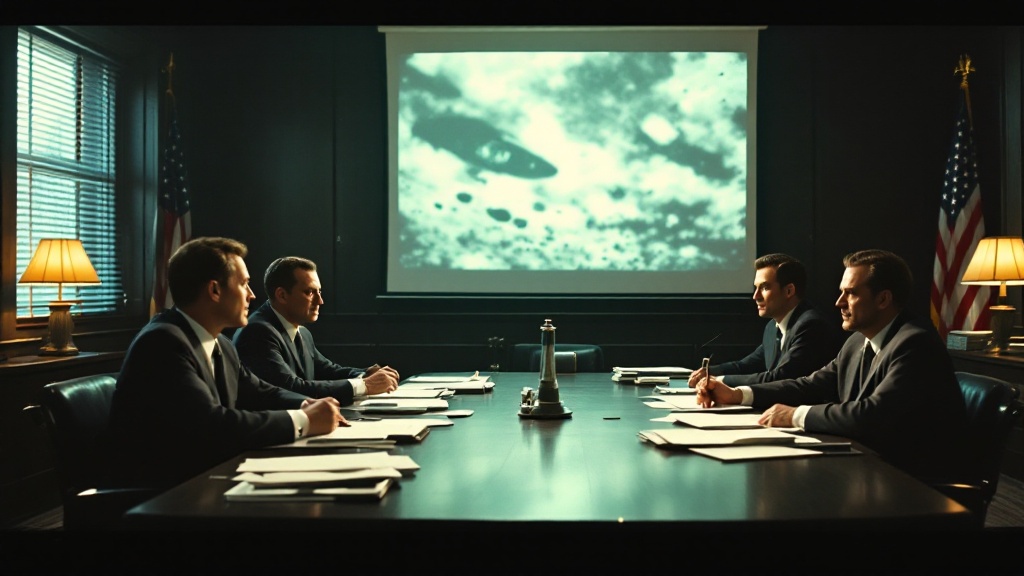
The CIA Robertson Panel of 1953: How 5 Scientists Dismissed UFOs in 5 Days
In January 1953, the CIA asked five scientists to decide whether UFOs were a threat to national security.
The scientists met for five days. They spent a total of 12 hours in formal sessions. They reviewed 23 cases out of 2,331 on file with the Air Force. That is about one percent of the available record.
Then they concluded that the entire subject was not worth studying.
CIA-UAP-002, the Scientific Advisory Panel on Unidentified Flying Objects report from 1952-1953, is now in the PURSUE archive. The file is 13 megabytes of scanned documents from the CIA’s Office of Scientific Intelligence. It includes the panel’s formal report, the supporting case histories, the meeting minutes recorded by CIA officer Frederick Durant, and the routing slips that show how the document moved through the intelligence bureaucracy.
You can read it yourself. That is the point.
For 70 years, the Robertson Panel has been discussed in books and articles that summarize its conclusions. Most of those summaries leave out the details. The PURSUE file gives you the details: which cases the panel looked at, which evidence they dismissed, which arguments they made, which recommendations they issued to the rest of the government.
The details tell a different story than the summary.
Who Was on the Panel
The panel was not a random group of academics. It was hand-picked by the CIA’s Office of Scientific Intelligence, and every member had specific expertise relevant to the UFO problem.
Dr. H.P. Robertson chaired the panel. He was a physicist at Caltech who had worked on classified weapons programs during WWII and maintained close ties to the intelligence community. He was not a UFO researcher. He was a man the CIA trusted to give them a straight answer.
Dr. Luis Alvarez was a physicist and radar expert who would later win the Nobel Prize in Physics in 1968. His role on the panel was to evaluate cases involving radar sightings. If anyone could tell the difference between a radar artifact and a real object, it was Alvarez.
Dr. Thornton Page was an astrophysicist and radar expert who served as deputy director of the Office of Science at the State Department. He was assigned the green fireball reports and nocturnal light cases.
Dr. Samuel Goudsmit was a nuclear physicist at Brookhaven National Laboratory, best known for discovering electron spin. He brought a skeptical, evidence-first perspective.
Dr. Lloyd Berkner, a space scientist, joined the panel on Friday afternoon of the five-day session. His late arrival is a detail worth noting. He participated in less than two of the five days.
Frederick Durant, a CIA officer and missile expert, served as the panel’s secretary. He wrote the longer internal report that surrounded the panel’s formal conclusions. That document is often called the Durant Report. It contains the case discussions, the panel members’ off-the-record comments, and the institutional context that the formal report leaves out.
Five scientists. Five days. Twelve hours of formal sessions. One percent of the cases.
What the Panel Actually Did
The panel met from January 14 through January 18, 1953, in Washington, D.C. The sessions took place at the CIA’s request, following a wave of UFO reports in the Washington, D.C. area in July 1952 that had generated intense media coverage and public concern.
On the first day, the panel viewed two amateur motion pictures. The first was the Tremonton, Utah film from July 2, 1952, shot by Navy Chief Petty Officer Delbert Newhouse, who had extensive experience with aerial photography. The film showed bright, maneuverable objects that Newhouse reported as unknown. The second was the Great Falls, Montana film from August 15, 1950.
Two Navy film analysts, Lieutenants R.S. Neasham and Harry Woo, then presented their conclusions. They had spent approximately 1,000 man-hours analyzing the Tremonton film frame by frame. Their conclusion was that the objects in the film were not birds, balloons, or aircraft. They were self-luminous because they did not blink as they passed through 60 degrees of arc.
The panel rejected this conclusion.
Thornton Page had requested that a film of seagulls be shown for comparison. The panel felt the Tremonton objects were probably birds. The Navy analysts who had spent 1,000 hours on the film disagreed. The panel overruled them in a matter of hours.
On the second day, Air Force Captain Edward Ruppelt, who headed Project Blue Book, finished his presentation. J. Allen Hynek, then an astronomy consultant to the Air Force, discussed the upcoming Battelle statistical study that would later become Project Blue Book Special Report 14. The panel discussed the problems with monitoring UFO sightings.
Over the remaining days, the panel reviewed a selection of cases. The formal list included Bellefontaine, Ohio (August 1, 1952); Tremonton, Utah (July 2, 1952); Great Falls, Montana (August 15, 1950); Yaak, Montana (September 1, 1952); the Washington, D.C. area (July 19, 1952); Haneda Air Force Base, Japan (August 5, 1952); Port Huron, Michigan (July 29, 1952); and Presque Isle, Maine (October 10, 1952). About 15 others were discussed in less detail.
After reviewing these cases, the panel concluded that “reasonable explanations could be suggested for most sightings” and that “by deduction and scientific method it could be induced (given additional data) that other cases might be explained in a similar manner.”
That is a critical sentence. The panel did not solve the cases. It suggested that they could probably be solved, given more data, by extrapolation from the ones that seemed explainable. The word “induced” is doing a lot of work in that sentence. It means the panel was guessing.
The Conclusions
The panel’s formal report was short. Its main conclusions were:
-
The evidence presented on UFOs shows no indication that these phenomena constitute a direct physical threat to national security.
-
There is no residuum of cases that indicates phenomena attributable to foreign artifacts capable of hostile acts. There is no evidence that the phenomena indicate a need for the revision of current scientific concepts.
The second conclusion is the one that has aged worst. “No residuum of cases” means no leftover cases after explanation. The panel was saying that every case could be explained, even the ones they had not actually explained. They said this after reviewing 23 out of 2,331 cases.
The panel also noted an indirect threat: that public interest in UFOs could overwhelm military communication channels during a real attack. This is the argument that justified the panel’s most consequential recommendation.
The Recommendations
The panel did not just conclude. It recommended action. And the recommendations are where the file gets uncomfortable.
The panel recommended that national security agencies “take immediate steps to strip UFOs of the special status they have been given and the aura of mystery they have unfortunately acquired.”
The mechanism was a public education campaign. The CIA considered using entertainment properties, including Disney productions and The Lone Ranger, to shape public perception. The goal was not to share what the government had found. The goal was to reduce public interest in the subject.
The panel also recommended monitoring civilian UFO groups, because they “might be prone to manipulation by foreign powers.” And it recommended limiting the Air Force’s reporting system to reduce the volume of incoming reports.
Read those recommendations again. A government panel reviewed one percent of the available evidence, concluded that the subject was not worth studying, and then recommended that the government actively shape public opinion to reduce interest in the subject. It recommended monitoring private citizens who were interested in the subject. It recommended reducing the data collection that might have allowed future scientists to study the phenomenon.
This is not a conspiracy theory. This is what the document says.
The Tremonton Film and the Seagull Problem
The Tremonton, Utah case deserves a closer look because it shows how the panel handled its strongest evidence.
Delbert Newhouse was a Navy Chief Petty Officer with 2,000 hours of flight time and extensive experience as an aerial photographer. On July 2, 1952, while driving near Tremonton with his wife, he saw a formation of bright, silver-gray objects in the sky. He pulled over and filmed them with a Kodachrome movie camera. The film contained approximately 1,600 frames showing objects that moved in formation, changed direction, and appeared to be self-luminous.
The Navy Photo Interpretation Laboratory spent 1,000 man-hours analyzing the film. Their conclusion: the objects were not birds, balloons, or aircraft. They were self-luminous. The analysts were confident enough in their work to state this on the record.
The Robertson Panel disagreed. They said the objects were probably birds. Thornton Page brought in a film of seagulls for comparison, and the panel felt the comparison was sufficient.
Here is the problem. Newhouse was an experienced aerial photographer. He saw the objects with his naked eye before he started filming. He described them as bright and silver-gray, not as birds. The Navy lab spent 1,000 hours on the analysis. The panel spent part of an afternoon.
The panel’s dismissal of the Tremonton film is not necessarily wrong. Birds can reflect sunlight and appear bright on film. Apparent motion in a film can be caused by camera movement. But the panel’s confidence in its conclusion, given the brevity of its review and the depth of the Navy’s analysis, is worth questioning. The panel did not prove the objects were birds. It asserted that they probably were and moved on.
That pattern repeats throughout the file. The panel did not solve cases. It suggested solutions and treated the suggestions as conclusions.
How the Robertson Panel Shaped 70 Years of UAP Policy
The Robertson Panel’s recommendations were adopted. That is the critical fact.
After January 1953, the Air Force’s approach to UFO reports shifted. Project Blue Book continued, but its emphasis moved from investigation to explanation. The goal was no longer to understand the phenomenon. The goal was to reduce the number of unexplained cases and to manage public perception.
J. Allen Hynek, who served as the Air Force’s scientific consultant from 1948 through 1969, eventually became a critic of this approach. In his 1972 book The UFO Experience, Hynek wrote that the Robertson Panel had set a tone of “ridicule and derision” that made scientific study of UFOs professionally risky for decades. He argued that the panel’s recommendation to strip UFOs of their “aura of mystery” had effectively stripped them of their scientific legitimacy as well.
Hynek was not an outsider. He was the Air Force’s own consultant. He had been in the room with the Robertson Panel. And he came to believe that the panel had made a mistake that cost the country decades of potential research.
The panel’s influence did not stop with Project Blue Book. The approach it recommended, treating UFO reports as a public relations problem rather than a scientific one, became the default institutional posture. When the Condon Committee was formed in 1966 to review the Air Force’s UFO program, it operated under the same assumption: that the goal was to justify ending the program, not to study the phenomenon. The Condon Report’s 1969 conclusion that further study was not warranted echoed the Robertson Panel’s 1953 conclusion almost word for word.
The UAP Science Advisory Council announced in June 2026 represents the first time the U.S. government has formally reversed that posture. Where the Robertson Panel said “stop studying this,” the Science Advisory Council says “we must study this.” Where the Robertson Panel recommended reducing public interest, the Science Advisory Council promises to publish its findings in peer-reviewed journals.
The contrast is exact. The question is whether the new council will have more than 12 hours and 23 cases to work with.
What the PURSUE File Adds
The Robertson Panel report has been available through the CIA’s FOIA reading room for years. The Black Vault and NICAP have hosted copies for decades. So what does the PURSUE version add?
Two things.
First, context. The PURSUE archive places CIA-UAP-002 alongside the related documents that surrounded the panel’s work. DOW-UAP-D085, the Department of War’s transmission of the CIA panel report, shows how the panel’s conclusions were distributed to other agencies. CIA-UAP-015, Project Blue Book Special Report No. 14, shows the Battelle study that was discussed during the panel’s sessions. Reading these documents together gives you a picture of the institutional machinery that processed UFO reports in the early 1950s, not just the panel’s isolated conclusions.
Second, accessibility. The PURSUE archive is a public-facing system designed for people who want to read the primary sources. The CIA’s FOIA reading room requires you to know what you are looking for. The PURSUE archive lets you browse by agency, by date, and by category. That difference matters because the Robertson Panel’s impact came not just from its conclusions but from the institutional system that carried those conclusions forward for decades.
Common Questions About the Robertson Panel
What was the Robertson Panel?
The Robertson Panel was a CIA-convened scientific advisory panel that met from January 14 to January 18, 1953, to review UFO reports collected by the U.S. Air Force. It was chaired by Caltech physicist H.P. Robertson and included four other scientists: Luis Alvarez, Thornton Page, Samuel Goudsmit, and Lloyd Berkner. The panel’s formal name was the Scientific Advisory Panel on Unidentified Flying Objects, convened by the CIA’s Office of Scientific Intelligence.
What did the Robertson Panel conclude?
The panel concluded that UFOs did not constitute a direct physical threat to national security. It found no evidence that any UFO report indicated foreign technology capable of hostile action. It also concluded that the remaining unexplained cases could probably be explained with further study, even though the panel itself did not provide those explanations. The panel recommended a public education campaign to reduce public interest in UFOs and the monitoring of civilian UFO groups.
How many cases did the Robertson Panel review?
The panel reviewed 23 cases out of 2,331 on file with the Air Force. That is approximately one percent of the available record. The panel spent 12 hours in formal sessions over five days. The cases it reviewed were selected by the Air Force as the best-documented incidents on file.
Who was on the Robertson Panel?
The panel had five members: Dr. H.P. Robertson (physicist, Caltech), Dr. Luis Alvarez (physicist and radar expert, later Nobel laureate), Dr. Thornton Page (astrophysicist and radar expert), Dr. Samuel Goudsmit (nuclear physicist, Brookhaven National Laboratory), and Dr. Lloyd Berkner (space scientist, who joined on the final day). Frederick Durant, a CIA officer, served as secretary.
Was the Robertson Panel report classified?
Yes. The report was originally classified Secret because it contained details about U.S. military capabilities and intelligence activities. It was declassified and released through the CIA’s FOIA program in the 2000s. The PURSUE archive now includes the declassified version as CIA-UAP-002.
Did the Robertson Panel look at the foo fighter reports from WWII?
The panel referenced WWII-era reports, including what it called “Foo Fighters,” in its case discussions. The panel noted that these sightings had been made by aircraft pilots during World War II and that the objects were never identified. However, the panel treated these historical reports as part of the broader pattern of sightings that could probably be explained with better data, rather than investigating them as a distinct phenomenon. For more on the original foo fighter reports, see the 415th Night Fighter Squadron files.
How did the Robertson Panel affect J. Allen Hynek?
Hynek was present during the panel’s sessions as the Air Force’s scientific consultant. He initially supported the panel’s approach. Over time, he came to believe that the panel had made a serious mistake by treating UFO reports as a public relations problem rather than a scientific one. In his 1972 book The UFO Experience, Hynek argued that the panel’s recommendation to strip UFOs of their “aura of mystery” had made scientific study of the phenomenon professionally risky for decades. He later coined the term “close encounter” and became one of the most prominent scientific advocates for UFO research.
What This Means for UAP Research Today
The Robertson Panel is not just a historical curiosity. It is the template for how institutions handle UAP reports when they would rather not.
The pattern is recognizable. Convene a panel. Review a small sample of cases. Suggest that the cases could probably be explained. Recommend reducing public attention. Move on. Do not study the phenomenon. Manage the reaction.
That pattern was followed in 1953, in 1969 with the Condon Report, and arguably in 2024 with AARO’s Historical Record Report. Each time, the conclusion was that there is nothing worth studying. Each time, the conclusion was reached without examining the full record.
The PURSUE archive is what makes the difference visible. For the first time, the public can read the primary sources that the Robertson Panel reviewed, the documents that the panel did not review, and the institutional correspondence that shows how the panel’s conclusions were distributed. You do not have to trust the summary. You can read the file.
The Robertson Panel met for 12 hours and looked at 23 cases. You have more time than they did, and you have access to more documents than they ever saw.
That is the opportunity.
Flynn Lin is the founder and editor of UFO Declassified. You can reach him at contact@ufo-declassified.com for corrections, tips, or questions about any record on this site. Read more about the PURSUE archive or browse all declassified documents.