Harare Airport UAP: A CIA High-Alert Cable Is Not an Answer
The Harare airport file is one of the most cinematic records in War.gov Release 03. That is also what makes it dangerous to read too quickly.
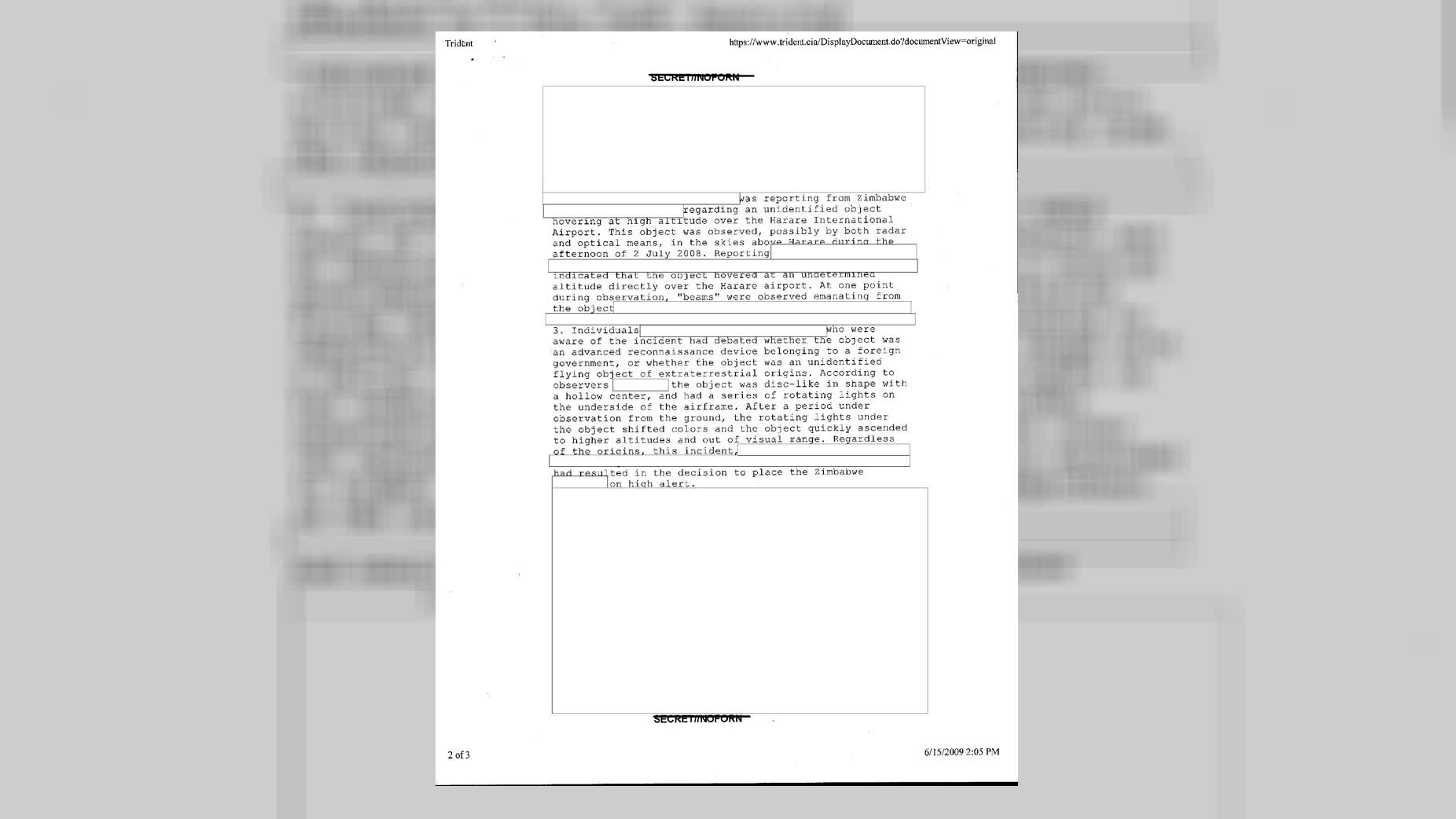
The public record describes an unidentified object over Harare International Airport in Zimbabwe in July 2008. It was reportedly seen at high altitude, possibly by both radar and optical means. The object was described as disc-like, with a hollow center, rotating lights, beams of light, and a rapid ascent out of visual range. The incident was serious enough, according to the CIA cable, to contribute to a decision to place a Zimbabwe-related target on high alert.
That is a strong hook. It is not a conclusion.
The core record is CIA-UAP-017, “Placement On High Alert Due To Perceived Aggressive Foreign Posturing”, released in the Department of War’s third PURSUE tranche on June 12, 2026. The file is short, heavily redacted, and written as an intelligence report rather than as a public case study.
That format matters.
The cable does not give the public a complete airport incident file. It does not include original radar returns, air-traffic-control audio, witness statements, photographs, video, aircraft logs, meteorological data, or a later analytic judgment. It preserves a reported incident inside a classified intelligence distribution chain.
The careful reading is therefore narrow: the Harare record shows that a report of an unidentified object over a major airport entered a serious U.S. intelligence channel and was treated as potentially consequential. It does not publicly identify the object.
That distinction is the article.
What The CIA Cable Says
CIA-UAP-017 is dated around early July 2008 and concerns Zimbabwe. The visible subject line refers to placement on high alert due to perceived aggressive foreign posturing. Much of the operational detail is redacted, but the central UAP passage is readable enough to understand why the file attracted public attention.
The report says a source was reporting from Zimbabwe about an unidentified object hovering at high altitude over Harare International Airport. The object was observed in the skies above Harare during the afternoon of July 2, 2008. The cable says the object was possibly observed by both radar and optical means.
That phrase is important, but it must be handled carefully.
“Possibly by both radar and optical means” is not the same as public radar evidence. It tells us the reporting channel claimed or suggested more than naked-eye observation. It does not show the radar data, identify the radar system, state who controlled it, give track numbers, provide altitude or speed, or explain whether the optical observation was through binoculars, cameras, airport personnel, military observers, or another source.
The cable then describes the object as hovering at an undetermined altitude directly over the airport. At one point, beams were reportedly observed emanating from the object. Individuals aware of the incident debated whether it was an advanced reconnaissance device belonging to a foreign government or an unidentified flying object of extraterrestrial origins.
The visible description says observers described the object as disc-like with a hollow center and a series of rotating lights on the underside. After a period of ground observation, the lights reportedly changed colors and the object quickly ascended to higher altitude and out of visual range.
The cable ends the visible section by saying that, regardless of origin, the incident contributed to a decision to place the Zimbabwe-related target on high alert. The exact organization or asset placed on alert is redacted.
That is the public file.
It is striking. It is also thin.
Why “High Alert” Matters
The most important phrase in this case is not “disc-like.” It is “high alert.”
Public UFO discussion often focuses on object description: shape, color, beams, movement, lights. Those details are memorable, but they are also the easiest part to misunderstand. A report can describe something vividly without proving what caused it.
The high-alert context is different. It suggests the reported event mattered to someone inside an intelligence or security workflow. The distribution list at the top of the cable is broad. It routes through U.S. national-security, military, intelligence, transportation, and law-enforcement entities. The file therefore shows that the report was not merely a local rumor after the fact. It entered an official channel and was circulated as sensitive intelligence.
That gives the case institutional weight.
But institutional weight is not the same as factual certainty.
Intelligence systems often react to uncertainty before they understand it. That is the point of alerting. If an object is reported over a major airport and one possible interpretation is foreign reconnaissance, the system does not need to know the object’s identity before it treats the report as potentially important. It only needs the situation to be uncertain enough, and consequential enough, to justify attention.
That is why the Harare file is useful. It shows how a UAP-like report can matter operationally without being solved publicly.
The cable’s value is not that it proves an exotic object. Its value is that it places the sighting inside a risk environment: airport airspace, possible radar or optical observation, foreign-government concern, and a security response.
That is a different kind of evidence from a phone video or witness interview.
Why The Description Is Not Enough
The Harare object description is unusually vivid. A disc-like shape with a hollow center. Rotating lights. Beams. Color changes. Rapid ascent. Directly over an international airport.
That language explains why the case traveled quickly in mainstream coverage. The Associated Press highlighted the Zimbabwe file alongside the more recent Colorado Springs object, the Western U.S. orbs, and the Northeastern red sphere. The Guardian included the Harare account in a broader skeptical frame, emphasizing that the release contained strange lights and objects but few hard facts.
Both framings are fair as far as they go. The description is attention-grabbing. The evidence is incomplete.
Shape descriptions can be unstable. A distant light arrangement can appear as a structure. A rotating light pattern can create the impression of a solid object. “Beams” can refer to searchlights, reflections, atmospheric scattering, sensor artifacts, or actual emitted light. Rapid ascent can describe physical motion, loss of visibility, viewing angle, cloud entry, sensor transition, or a witness interpretation of disappearance.
None of those ordinary possibilities disproves the report. They simply show why a description cannot carry the whole case.
The public cannot evaluate a “disc-like” object over an airport without basic measurements. How high was it? How long was it observed? How many observers saw it? From where? Was it tracked continuously? Was the radar return correlated with the visual observation? Were aircraft delayed or rerouted? Did pilots report it? Did air-traffic controllers record unusual traffic? Was there weather, smoke, haze, military activity, or a known aviation event in the area?
Those questions are not skeptical decoration. They are the case.
Without them, the public has a serious report, not an identification.
The Foreign-Reconnaissance Question
One of the most useful details in CIA-UAP-017 is the debate over possible origin.
The cable says individuals aware of the incident debated whether the object was an advanced reconnaissance device belonging to a foreign government or an unidentified flying object of extraterrestrial origins. That is a remarkable sentence, but it does not mean the CIA endorsed either conclusion.
It tells us possible interpretations were being discussed.
In 2008, an unexplained object over an airport would naturally raise aviation and security concerns. If the report was connected to radar and optical observation, foreign reconnaissance would be a rational concern to test. The relevant question would not be “Is it alien?” The relevant question would be: could this be a surveillance platform, military aircraft, drone, balloon, electronic warfare asset, satellite-related misinterpretation, or a local system misunderstood by observers?
The extraterrestrial-language detail is newsworthy because it appears inside a CIA file. But the responsible reading is to treat it as part of the reported debate, not as a finding.
The public record supports this narrower claim: people aware of the incident debated extraordinary and national-security explanations because the report was unresolved and potentially sensitive. It does not show that either explanation was confirmed.
That is why this case belongs in a historical intelligence-file article rather than in a solved-case article.
What Makes It Different From The Modern Orb Cases
Harare differs from the Western U.S. orbs, the Northeastern red orb, and the Colorado Springs object in one important way: the public artifact is not a modern case packet built around witness interviews or an AARO analysis. It is a short intelligence cable.
That makes it less visually accessible but more institutionally interesting.
The Western U.S. orbs case has official analysis, multiple witness narratives, renderings, and a partial conventional explanation. The Northeastern red orb case has witness interviews, a video attachment, site visits, and a recurring-location problem. Colorado Springs has witness statements, a forensic sketch process, and a low-confidence natural explanation.
Harare has something else: an intelligence alarm.
It does not give us enough to reconstruct the sky. It gives us a glimpse of how a report moved through official attention. That is valuable because public UAP discussion often treats government documents as if they all serve the same function. They do not.
A video file is a visual artifact. An interview is testimony. A forensic sketch is a witness-memory aid. An AARO analysis is an assessment. A historical cable is a communication inside a decision environment.
CIA-UAP-017 belongs to the last category.
The right question is not, “Does this cable prove a craft was over Harare?” The right question is, “What would the underlying case file need to contain for the public to evaluate why this cable triggered concern?”
What Future Records Should Add
The Harare case could become much stronger if future releases added the missing operational record around the July 2, 2008 event.
The public should look for:
- Original radar records from Harare International Airport and any relevant military or regional air-defense systems.
- Air-traffic-control audio and logs for the afternoon observation window.
- A list of aircraft movements, delays, holds, diversions, or pilot reports from that time.
- Weather data, including cloud cover, visibility, haze, wind, and atmospheric conditions.
- Witness statements from airport personnel, pilots, security staff, air-traffic controllers, or military observers.
- Any photographs, video, or optical-instrument records mentioned or implied by the phrase “optical means.”
- The redacted analytic sections explaining who was placed on high alert and why.
- Any follow-up assessment, correction, debunking, foreign-intelligence review, or closure record.
Those records would not automatically make the incident extraordinary. They might make it ordinary. They might show a foreign platform, an aviation event, a sensor problem, a misinterpretation, or something still unresolved. But they would move the case from dramatic intelligence fragment to testable public record.
That is the work Release 03 starts but does not finish.
Why This File Belongs In The Archive
The Harare airport cable matters because it preserves a UAP-adjacent event in a context where uncertainty had consequences.
It is easy to dismiss old files as dusty curiosities. It is also easy to inflate them because they look classified. Both moves are wrong.
The file should be treated as a historical intelligence artifact. It shows a report, a distribution chain, a sensitive national-security context, and a security response. It also shows redaction, missing source detail, and no public final answer.
That combination is exactly why historical UAP records remain useful. They do not merely tell us what people claimed to see. They show what institutions chose to preserve, route, classify, and later release.
Harare is not important because it gives readers a clean image of a disc over an airport. It does not. It is important because it shows a reported event moving from observation into intelligence concern.
That is a serious threshold.
It is not the final threshold.
Bottom Line
The Harare airport UAP file is one of the most compelling records in War.gov Release 03 because it joins three things that rarely appear together in public: a vivid object description, a major airport setting, and a CIA high-alert context.
But the released cable is not a complete case file.
The public record supports a narrow conclusion: in early July 2008, U.S. intelligence recorded a report of an unidentified object over Harare International Airport, possibly observed by radar and optical means, described as disc-like with rotating lights and beams, and treated as serious enough to contribute to a high-alert decision. The public record does not identify the object, verify every observation, or reveal the underlying data.
That makes CIA-UAP-017 important, not decisive.
The best next step is not belief or dismissal. It is reconstruction. Release the radar, air-traffic, witness, weather, and follow-up records. Then the public can evaluate whether Harare was a foreign-reconnaissance concern, a misidentified aviation or atmospheric event, a sensor-and-perception problem, or a genuinely unresolved UAP case.
Until then, the most honest headline is simple: a CIA high-alert cable is evidence that the report mattered. It is not evidence that the mystery has been solved.