Northeastern Red Orb: Video Is Evidence, Not Identification
The Northeastern Red Orb case is one of the easiest War.gov Release 03 stories to share and one of the hardest to judge.
It has the elements that travel quickly: a brilliant red sphere, a white center, a second object, silent movement over trees, a cellphone video, and FBI interview records. Mainstream coverage noticed it because the image is simple. A red orb in a backyard is more memorable than a dense redacted file.
But that is exactly why this case needs careful handling.
The public record supports a narrow claim: witnesses in the northeastern United States reported seeing unusual orb-like lights, the FBI recorded interviews and site visits, and at least one video attachment became part of the public release package. The record does not publicly establish what the object was, how far away it was, how large it was, how fast it moved, or whether the video shows the same geometry the witnesses perceived in person.
That distinction is the whole article.
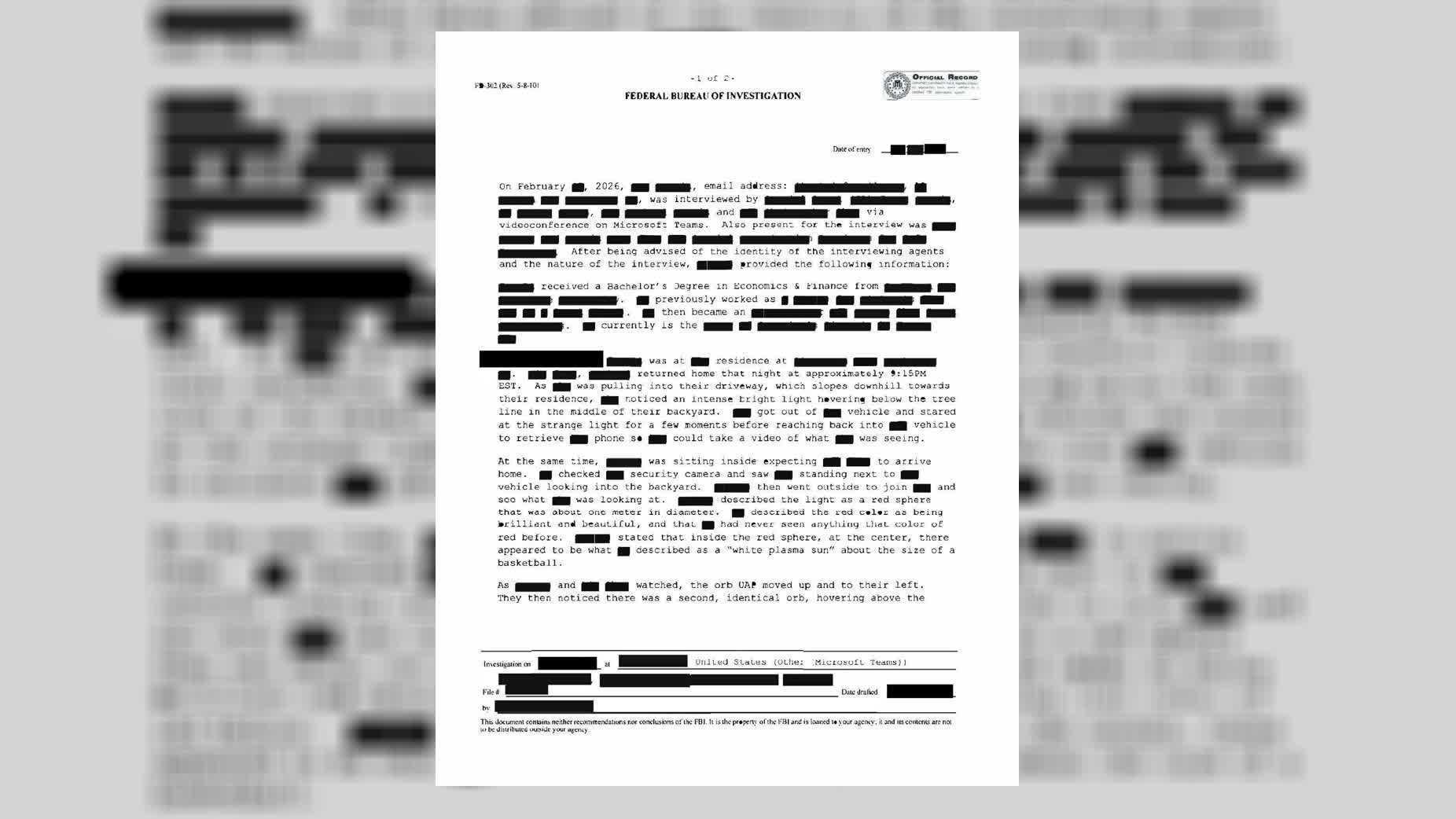
The core red-orb records are FBI-UAP-D009, “FD 302 67 Northeastern Orb Sighting 2026” and FBI-UAP-D010, “FD 302 71 Northeastern Orb Sighting 2026”, released through the Department of War’s PURSUE archive on June 12, 2026. They should also be read beside the earlier Northeastern property files: FBI-UAP-D004, D005, D006, D007, and D008.
Together, those files show two connected evidence problems.
The first is a recurring-location problem: a witness reported repeated lights near a property, tried to document them, and agents later visited the site. The second is a public-video problem: a vivid red-orb account became highly visible before the public received the technical context needed to test it.
Those problems are related, but they are not the same.
What The Red Orb Witnesses Reported
FBI-UAP-D009 records a video-conference interview about a nighttime sighting in the northeastern United States. The witness had returned home around 9:15 p.m. Eastern time and saw an intense light in the backyard area. Another person came outside after seeing the witness on a security camera.
The witness described the object as a red sphere roughly one meter across. At the center, the witness perceived a smaller white interior light. A second similar orb was then noticed above the first. The two objects reportedly moved together toward the west above the tree line, changed altitude and direction, and remained silent. The witness said they appeared to move together as if in formation or connected.
The account also says video was captured after the objects were above the trees and moving away from the backyard.
FBI-UAP-D010 records another witness account. That witness described arriving home, seeing a yellowish ball of light, then seeing a second larger light near or behind a row of trees. The account places the objects relatively close to the property and low above the ground from the witness perspective. The objects reportedly moved laterally, passed behind trees or a neighboring structure, and then one light appeared to enter the other before disappearing.
The two records are valuable because they preserve separate witness perspectives on the same broad event. They are also limited because the public files do not provide the original video metadata, camera settings, precise camera position, lens information, full-resolution frame sequence, environmental reconstruction, or a measured line of sight.
Without those details, the video is evidence that something was recorded. It is not, by itself, an identification of what was recorded.
That sounds obvious, but it is the point most likely to get lost.
The Older Northeastern Files Matter
The red-orb interviews should not be read in isolation.
Release 03 also includes a cluster of 2024 FBI records about repeated observations near a property in the northeastern United States. Those files begin with a person reporting multiple videos of unknown unmanned systems or UAP near a residence. The reported observations dated back to late 2021. The witness described lights near the home, near trees, near water, and sometimes close to the ground.
The witness also described attempted data collection with trail cameras and other equipment. The files note claims about unusual electronics behavior, GPS effects, and radiation readings. Those claims are part of the record, but they should be treated carefully. A claim that a reading correlated with a sighting is not the same as a calibrated scientific measurement released with methodology, timestamps, sensor model, error range, and raw data.
The most useful part of the older Northeastern file set is that agents visited.
FBI-UAP-D006 records a site survey. Agents walked the property, looked at areas where activity had reportedly been seen, and noted a wooded area, trail-camera placement, a nearby water feature, and surrounding lines of sight. The record also notes that multiple homes existed along the line of sight. That is important because lights seen near or through trees can have many possible sources: aircraft, vehicles, homes, reflections, handheld lights, drones, celestial objects, camera artifacts, or something less ordinary.
FBI-UAP-D007 is more interesting. It records an agent visit for surveillance in November 2024. Agents observed lights from the patio or backyard area near dusk. The file describes pulsing lights near the tree line, erratic lateral movement, red and white flashes, and difficulty capturing useful photographs. The attempted photos were mostly blurry, and the record notes that better support equipment would be needed.
FBI-UAP-D008 records a later daytime walk-through. Agents checked the line of sight and did not find an obvious ground feature that explained the lights. The record also notes that flying a drone or similar craft at night through the tree cover would have been risky because of branches.
This matters because the older files make the Northeastern case more than a single backyard anecdote. They show a report pathway, a location, site visits, attempted documentation, and at least some agent observations of lights.
But they still do not close the case.
They do not publicly identify the lights. They do not provide a synchronized instrument package. They do not give the public a calibrated range, altitude, size, speed, or source.
The strongest careful reading is this: the Northeastern files justify further investigation, not final belief.
Why Video Makes The Case Stronger And Weaker
Video improves a UAP case because it gives future analysts something beyond memory. It can preserve movement, timing, brightness changes, background references, camera behavior, and audio context. In the Northeastern Red Orb case, the existence of video makes the public story more concrete than a text-only interview.
But video can also create false confidence.
A camera does not record reality the way a person experiences it. It records light through a lens, sensor, compression pipeline, stabilization system, exposure algorithm, and file format. At night, those layers matter even more. A bright point can bloom. Autofocus can hunt. Digital zoom can enlarge artifacts. A small nearby object and a large distant light can look similar. A motion-stabilized phone can make camera movement look like object movement, or object movement look smoother than it was.
This does not mean the Northeastern video is worthless. It means the video has to be treated as a technical object, not just a spectacle.
The public would need the original file, not a repost. It would need the file creation time, device model, lens setting, frame rate, exposure behavior, stabilization status, GPS and compass data if present, and whether the clip was edited or transcoded. It would also need the exact camera position and the direction of view. If the object moved behind trees, the trees become useful reference points. If a nearby house or pond is in the line of sight, those features become part of the reconstruction.
The video can be the beginning of analysis.
It cannot be the end of it.
The Public Attention Problem
The Associated Press highlighted the Northeastern red sphere because it is one of the most vivid details in Release 03. The Guardian framed the broader release more skeptically, emphasizing strange lights, unresolved cases, and the lack of hard facts. Both framings are understandable.
The red orb is newsworthy because it is visual and human. Someone came home, saw a strange light, called another person outside, watched it move, and recorded video. That is the kind of event readers can picture immediately.
The risk is that public attention compresses the case into a single phrase: “red orb video.”
That phrase leaves out the most important parts.
It leaves out the second witness. It leaves out the older Northeastern property reports. It leaves out the FBI site survey. It leaves out the agent surveillance visit. It leaves out the blurry attempted photos. It leaves out the trees, homes, water, dusk conditions, and possible ordinary light sources. It leaves out the missing metadata. It leaves out the difference between a witness description and a measured physical object.
That compression is not unique to UFO coverage. It happens in every visual mystery. A clip becomes a claim. A claim becomes a conclusion. A conclusion becomes a fight.
UFO Declassified should do the slower thing: keep the claim attached to the file.
What The Case Does Not Prove
The Northeastern Red Orb file does not prove extraterrestrial origin. It does not prove advanced technology. It does not prove a hidden aircraft, a drone, a plasma phenomenon, a hoax, or a misidentified ordinary light.
It also does not prove that nothing unusual happened.
The record is stronger than a casual social-media sighting because it sits inside an FBI file set, includes multiple witness accounts, connects to a broader Northeastern report trail, and includes official site activity. That makes it worth reading seriously.
But seriousness is not the same as certainty.
The witnesses’ language should be preserved as testimony. The video should be examined as a file. The site should be reconstructed as a geometry problem. The recurring-location material should be tested with instruments over time. None of those steps require ridicule. None require belief in advance.
The case becomes less mysterious, not more, when its limits are named clearly.
Why The Agent Site Visit Is The Most Useful Detail
The most interesting part of the broader Northeastern file set may not be the red orb itself. It may be the fact that agents went to the location and tried to observe from the witness’s property.
That matters because many UAP cases fail before anyone can return to the scene. A person sees something. The sighting ends. The object is gone. Investigators are left with memory, perhaps a video, and a vague direction. The original conditions cannot be recreated.
The Northeastern property case is different because it involved repeated reports from a location. That creates a chance for repeat observation, controlled cameras, environmental logging, and systematic exclusion of ordinary sources.
The existing files show that chance was recognized. Agents looked at the property. They observed lights. They tried to photograph them. They noted the need for better stability. They returned in daylight. They considered whether a drone-like explanation made sense in the tree environment.
That is exactly how a weak public mystery can become a stronger research case.
But the public record stops before the work becomes decisive. We do not see a deployed instrument package. We do not see synchronized cameras. We do not see controlled skywatch logs. We do not see ADS-B, radar, weather, satellite, astronomical, and local light-source checks tied to each observed event.
So the agent visit raises the case’s value, but it does not identify the object.
What Future Releases Should Add
The Northeastern Red Orb case would become much more useful if future releases added the materials needed to separate witness perception, camera behavior, and physical movement.
For the red-orb video, the public record needs:
- The original unedited video file or a forensically preserved copy.
- Metadata showing device model, time, frame rate, resolution, exposure, lens, and stabilization details.
- A redacted but usable map of the camera position, object direction, tree line, nearby structures, and relevant reference points.
- A frame-by-frame analysis of the object’s apparent motion relative to fixed background features.
- Weather, wind, cloud, humidity, visibility, moon phase, and astronomical conditions for the observation window.
- ADS-B, radar, drone, satellite, and local-airspace checks for the relevant time and direction.
- Any home-security footage mentioned in the witness account, with privacy redactions if needed.
- A clear note on whether the public video was compressed, cropped, edited, stabilized, or reposted before release.
For the recurring Northeastern property reports, the public record needs a different package:
- A timeline of all reported observations by date, time, direction, color, duration, and witness count.
- A record of every instrument used by the witness, including trail cameras and sensors.
- Raw sensor logs for any claimed radiation, GPS, or electronics anomalies.
- A list of excluded ordinary sources for each major observation.
- A description of any formal follow-up after the November 2024 agent observation.
- A controlled observation plan using multiple fixed cameras, independent time sources, and environmental sensors.
Those additions might make the case more extraordinary. They might make it ordinary. Either outcome would be progress.
The goal is not to protect the mystery.
The goal is to protect the evidence.
Bottom Line
The Northeastern Red Orb case is important because it shows how quickly a UAP record can become public mythology before the evidence is strong enough to carry the story.
The red sphere account is striking. The second witness matters. The video matters. The older Northeastern property files matter. The FBI site visits matter. The agent observations matter. All of that makes the case worthy of careful attention.
But the public record still lacks the data needed for identification.
The careful conclusion is narrow: Release 03 documents a vivid Northeastern orb sighting, related witness accounts, and a broader location-based investigation trail. It does not publicly establish the object’s nature. The video is evidence, but without original metadata, line-of-sight reconstruction, environmental checks, and independent sensor context, it is not an answer.
Start with FBI-UAP-D009 and FBI-UAP-D010, then read the older Northeastern property files from D004 through D008. The red orb is the hook. The evidence problem is the story.