ODNI Orange-Orb Narrative: Evidence, Not Verification
The most cinematic document in War.gov Release 02 is not a video.
It is a two-page narrative.
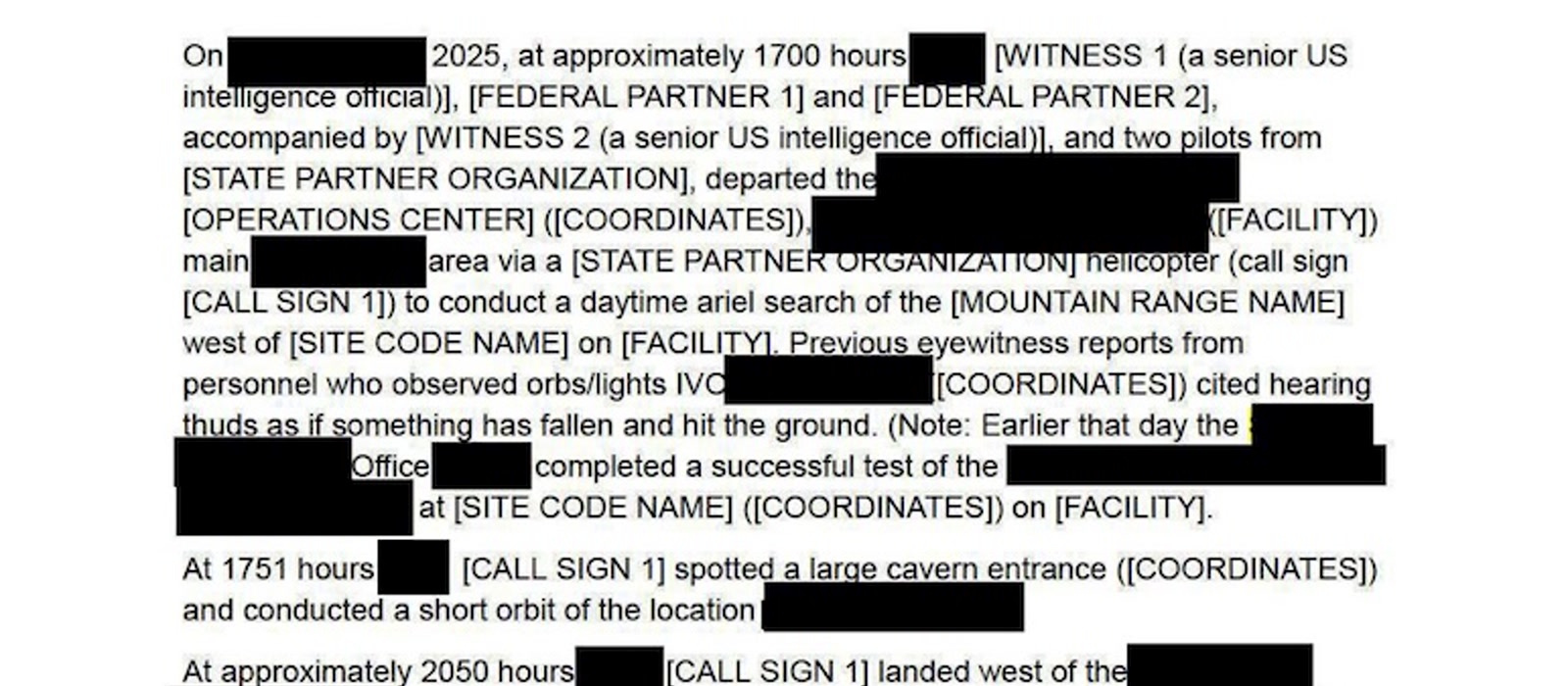
The record is ODNI-UAP-D001, “USPER Narrative, Senior USIC Official”. It describes a late-2025 helicopter search in the western United States involving a senior U.S. intelligence official, pilots, a Joint Operations Center, ground teams, radar hits, night-vision observations, FLIR reports, and repeated sightings of orange orb-like lights around mountains and aircraft.
That combination explains why mainstream coverage noticed it quickly. CBS News called it one of the most striking items in the second tranche. ABC News foregrounded the intelligence officer’s account of seeing orbs. The Guardian grouped Release 02 as videos plus first-hand testimony.
The hook is obvious. The harder question is what kind of evidence this document actually is.
The answer is important for the whole archive. ODNI-UAP-D001 is valuable. It is not just rumor, not just a social-media story, and not just an anonymous anecdote. It is an officially released, redacted narrative inside the second PURSUE file release announced by the Department of War on May 22, 2026.
But it is still a narrative record. It is not, by itself, a verified sensor package, a complete case file, or a final identification.
That distinction is the article.
What The Document Says Happened
The public version of ODNI-UAP-D001 is heavily redacted. Names, exact locations, coordinates, call signs, facilities, and partner organizations are withheld. What remains is a sequence of reported events.
The narrative begins with a helicopter mission launched from a Joint Operations Center during early evening daylight hours in late 2025. The stated purpose was to investigate loud thuds in a mountain range on a test range, after prior reports of orb-like lights in the same general area.
During the daylight search, the crew reportedly found debris from rockets or projectiles associated with years of weapons testing. They also observed a large cave entrance in terrain that did not allow a safe landing. Later, after refueling and after sunset, the crew resumed operations using night-vision goggles and FLIR while continuing to receive updates from the Joint Operations Center.
The account then moves from search activity into UAP reporting.
Ground teams reportedly saw a hot object on FLIR moving low to the ground at high speed. The object was described as changing direction and splitting. The helicopter crew then reportedly observed a close-range encounter near the aircraft, followed by additional orb sightings in the distance and near the helicopter.
The most striking portion describes orange, oval-shaped lights appearing near the helicopter, then additional lights forming below them. Later, similar lights were reportedly seen near fighter jets in the operating area, appearing in formation and moving with the aircraft before fading.
That is the public story in broad outline.
It is unusually vivid for a government UAP record. It has witnesses, a mission setting, a military range, ground-team inputs, radar prompts, aircraft, night vision, FLIR, and a clear emotional endpoint: the crew returned to the operations center and debriefed after a series of events they apparently could not explain.
Those elements make the narrative worth reading closely.
They also make it easy to overstate.
Why This Record Matters
ODNI-UAP-D001 matters because it is not simply a video label or a historical clipping. It is a first-person operational narrative placed into the official Release 02 archive.
That gives it three kinds of value.
First, it gives researchers a timeline. The document lays out a mission sequence: prior reports, daylight search, debris observations, cave observation, refueling, night search, radar tasking, ground-team FLIR reports, close-range sighting, fighter-jet context, return, and debrief. A timeline is not proof, but it is the beginning of a case structure.
Second, it names the evidence channels that should exist around the event. If the narrative is accurate, there may be radio logs, radar records, FLIR observations, night-vision observations, helicopter mission records, range-control records, ground-team reports, and debrief notes. The public does not have those materials in this release, but the narrative points toward them.
Third, it shows that Release 02 is not only a video dump. The public conversation has focused heavily on clips such as DOW-UAP-PR051, the Syrian instant acceleration record and DOW-UAP-PR071, the Lake Huron shootdown record. But the ODNI file shows another category: narrative material from inside the national-security system.
That category deserves its own method.
Video records ask one set of questions: what sensor, what distance, what range, what frame rate, what object size, what metadata, what chain of custody?
Narrative records ask another set: who reported, what role did the witness have, what other witnesses existed, what independent records correspond to the account, what was redacted, and what later assessment was made?
If the archive treats both as the same thing, readers will misunderstand both.
Testimony Is Not Nothing
Serious researchers should not dismiss testimony automatically.
Testimony can preserve information that sensors miss. A human observer can describe sequence, context, perceived proximity, cockpit or cabin reaction, radio flow, and operational urgency. In this case, the narrative also ties the experience to a mission environment rather than a random sighting.
That matters.
It also matters that the source is framed as a senior U.S. intelligence official rather than an unknown public witness. That does not make the account automatically true in every detail, but it does change how the record should be handled. Officially released testimony from a cleared national-security participant is not the same evidentiary category as a viral story with no provenance.
The document should therefore be treated as evidence of a reported operational experience.
That is a real category.
It is just not the final category.
Testimony can trigger investigation. It can define leads. It can identify records to request. It can reveal why an event mattered to the people present. But testimony alone cannot settle object identity, rule out misperception, establish exact altitude or distance, confirm radar correlation, or prove that multiple observers saw the same physical object.
For that, the public needs corroboration.
What The Public Still Does Not Have
The missing material is not a small footnote. It is the difference between a compelling story and a complete public case.
The released ODNI narrative does not include native radar tracks. It does not include the FLIR imagery reportedly used by ground teams. It does not include the helicopter’s sensor output. It does not include original radio audio. It does not include pilot statements as separate signed records. It does not include ground-team statements. It does not include fighter-pilot testimony. It does not include a range-control log. It does not include a post-event intelligence assessment.
It also does not show the public exactly where the incident occurred. The redactions may be justified by range security, personnel protection, or classified location details. But the effect is still clear: public readers cannot independently test geography, line of sight, distance, aircraft positions, weather, military activity, or possible range-related explanations.
That does not make the record worthless.
It means the record should be labeled correctly.
ODNI-UAP-D001 is a source document for a reported event. It is not a full evidentiary packet.
The difference matters because this particular account is emotionally powerful. It contains the kind of details that travel well online: glowing orange lights, mountains, a cave, a helicopter, radar hits, fighter jets, and experienced witnesses left without an explanation. Those details will attract confident interpretations.
The archive’s job is to slow that down.
The Cave Detail Is A Perfect Example
One reason this narrative will likely keep spreading is the cave detail.
During the daylight search, the crew reportedly saw a large cave entrance, could not land nearby, orbited for observation, noted the location, and continued. In a viral environment, that single detail can easily become the center of the story.
But the public document does not say the cave caused the sightings. It does not say the objects came from the cave. It does not say there was a base, tunnel, installation, or hidden technology inside. It says the crew saw a cave entrance during a search in a mountain range where previous reports had occurred.
That is worth noting.
It is not worth inflating.
This is the same discipline required for the whole Release 02 archive. A redacted file can contain a strange detail without that detail becoming the explanation. The better move is to ask what follow-up record would clarify it: coordinates, flight path, photos, range maps, later inspection notes, or a statement that the cave was unrelated.
Without that, the cave remains context, not conclusion.
The Fighter-Jet Detail Needs The Same Treatment
The account’s fighter-jet section is even more attention-grabbing.
According to the narrative, fighter jets entered the operating area, and orb-like lights appeared above or near them, matching their apparent path for short intervals before fading. The witness interpreted the repeated appearance as if the lights were following or pursuing the jets.
That is a dramatic claim.
It is also exactly the kind of claim that needs independent records.
If aircraft were present, there should be some combination of flight records, radar data, range logs, pilot communications, and possibly aircraft sensor data. If the orbs were only visible from the helicopter’s line of sight, that matters. If the fighter pilots saw nothing, that matters. If they saw something, that matters even more. If radar correlated with the lights, that matters. If radar did not, that matters too.
The public file does not answer those questions.
So the responsible public position is narrow: the ODNI narrative reports a witness interpretation involving orbs and fighter jets. It does not publicly verify the objects’ distance, size, altitude, speed, or relationship to the jets.
That narrow framing is not debunking. It is basic evidentiary hygiene.
How This File Should Be Classified By Readers
For this site’s archive, ODNI-UAP-D001 should be treated as a high-interest narrative record with unresolved corroboration.
It deserves a stronger status than “random anecdote.” It does not deserve the same status as a fully documented multi-sensor case.
A useful label set would look like this:
- Official public record: yes.
- First-person operational narrative: yes.
- Exact location public: no.
- Native sensor files public: no.
- Radar data public: no.
- Independent witness records public: no.
- Post-event assessment public: no.
- Object identity resolved from released material: no.
That list gives readers a way to respect the file without surrendering judgment.
It also helps separate ODNI-UAP-D001 from other Release 02 material. Compare it with the Sandia Base historical file, which works as a historical sensitive-site record, or the CIA Soviet intelligence report, which belongs in Cold War intelligence context. Each record type needs its own standard.
The ODNI narrative is not weak because it is testimony. It is incomplete because the corroborating case materials are not public.
That is the key distinction.
Why Mainstream Coverage Was Right To Notice It
Mainstream outlets were right to highlight the ODNI narrative. It is one of the few Release 02 items that a general reader can understand immediately.
Many military UAP videos require sensor literacy before a viewer can even begin to evaluate them. A short infrared clip might look dramatic, but without range, metadata, platform details, or target context, the public is often left guessing. The ODNI narrative is different. It tells a story with a beginning, middle, and end.
That makes it accessible.
It also makes it dangerous.
Stories create confidence faster than data does. A video without context can be confusing. A story with named roles, mission flow, and emotional reaction can feel complete even when the evidence package is thin. The reader can picture it, so the reader can believe it.
That is why source-first coverage needs to add friction in the right places.
The correct question is not whether the narrative is interesting. It plainly is.
The correct question is what public records would be needed to move it from interesting to verified.
What Future Releases Should Add
The Department of War says additional PURSUE releases are being prepared. If ODNI-UAP-D001 is expanded in a later tranche, the most useful additions would not be another summary.
The public needs connective tissue:
- A redacted mission timeline with times, aircraft roles, and tasking flow.
- Radar extracts or a plain-language explanation of why radar data cannot be released.
- FLIR or night-vision imagery tied to the reported ground-team observation.
- Separate pilot and ground-team witness statements.
- Any fighter-aircraft observations or a statement that none were recorded.
- Range activity context, including whether tests, training, drones, aircraft, flares, or other events overlapped.
- A post-event assessment explaining whether the incident remains unresolved.
Those materials would not automatically prove an extraordinary explanation. They would do something better: make the case testable.
That is the standard the archive should push toward.
The Bottom Line
ODNI-UAP-D001 is one of the most important documents in Release 02 because it shows what public UAP transparency looks like when the evidence is not a video.
It is an official narrative. It is detailed. It comes from a national-security context. It describes a multi-part event involving aircraft, ground teams, reported sensors, radar prompts, and orange orb-like lights. It deserves careful attention.
But it does not close the case.
The public still lacks the records needed to verify the most consequential parts of the account. That includes radar data, sensor imagery, separate witness records, radio traffic, flight logs, range context, and post-event analysis.
So the right conclusion is neither belief nor dismissal.
The right conclusion is that ODNI-UAP-D001 is a serious lead inside the public archive. It is evidence that a remarkable event was reported by a senior intelligence official. It is not public verification that the event happened exactly as perceived, or that the objects were what they seemed to be.
That is why the file matters.
It gives the public a story. Now the archive needs to give the public the records around it.