Western U.S. Orbs: The Strongest Release 03 Case Still Needs Data
The Western U.S. “orbs launching orbs” case is the most important modern incident in War.gov Release 03 because it sits exactly where serious UAP research becomes difficult.
It has trained federal law-enforcement witnesses. It has repeated observations over two nights. It has an AARO analysis update. It has several witness narratives, a notional map, and official renderings. It also has a direct analytic tension: AARO found that roughly 60 percent of the reported activity was plausibly attributable to military aircraft using infrared countermeasure flares, while roughly 40 percent remained unresolved after first-stage analysis.
That unresolved 40 percent is the story. But it is not a license to jump to an exotic conclusion.
The key record is DOW-UAP-D077, “Unresolved Case Analysis Update Western United States Event”, released in the Department of War’s third PURSUE tranche on June 12, 2026. The official portal describes PURSUE as a rolling effort to identify, review, declassify, and publicly release unresolved UAP-related records. It also states that these archived materials are unresolved cases where the government cannot make a definitive determination from the available information.
For this case, that boundary matters more than the nickname.
The public record supports a narrow claim: six federal law-enforcement special agents reported unusual orange and red light phenomena near a sensitive national security site in the western United States over two days in October 2023, and AARO determined that a significant portion of the reports still warranted further investigation after review against available logs, radar, spatial estimates, and ADS-B data.
It does not support a stronger claim that the objects were alien craft, that they were proven advanced technology, or that every reported movement occurred exactly as estimated by human observers in low-light conditions.
The file is valuable because it shows how far a serious public case can go without becoming a complete case packet.
What The Official Record Says
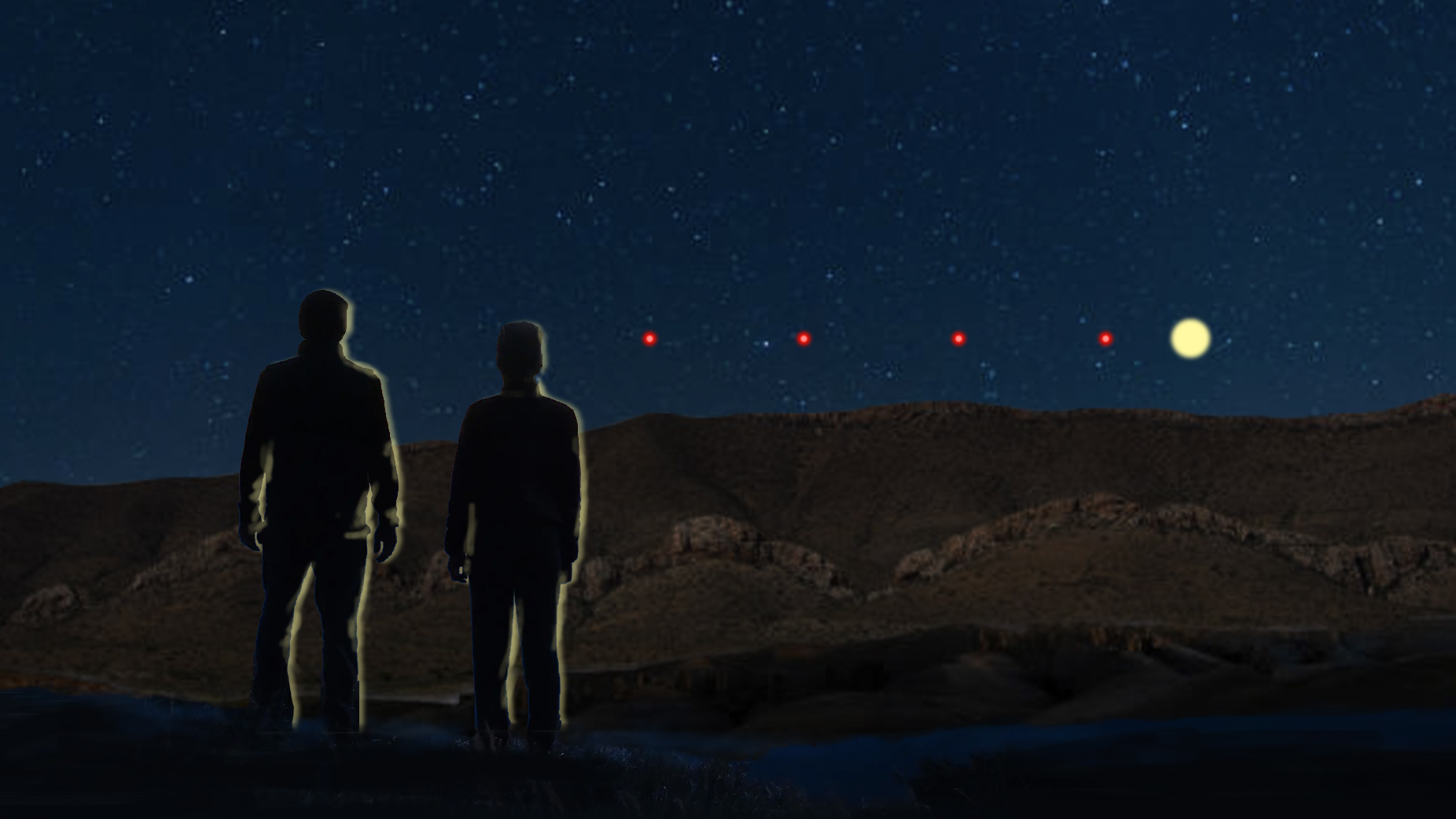
DOW-UAP-D077 summarizes an incident near a sensitive national security site in the western United States. Over a two-day period in October 2023, teams of two federal law-enforcement agents reported seeing luminous orange “mother orbs” produce smaller red “orbs” around dusk. The witnesses described the orange lights as appearing briefly, releasing clusters of two to four red lights, and then disappearing. The red lights reportedly moved with varied profiles, including coordinated horizontal motion and apparent altitude changes.
In at least one account, a red orb reportedly stayed stationary above a ridgeline for several hours.
AARO’s memo is careful about source language. It says its use of witness-derived descriptive wording preserves the integrity of firsthand narratives. That is the right approach. The phrases are vivid because the witnesses used vivid words. But the memo does not treat the language itself as measurement.
The most important line in the case may be the least dramatic one: the agents did not collect video footage, photographic imagery, or other technical data during the incident.
That means the case depends heavily on testimony, cross-checking, and exclusion. AARO reviewed the reports against commercial and military flight logs, radar data, spatial estimates, and ADS-B data. It also considered several hypotheses: military aircraft exhaust, UAVs, military aircraft dispensing flares, U.S. developmental or operational capabilities, foreign intelligence activity, environmental phenomena, space-based phenomena, and unrecognized technology.
The analysis does not flatten those possibilities into one answer. It separates them.
Military aircraft exhaust was ruled out. UAVs were assessed as unlikely. Foreign intelligence activity was assessed as highly unlikely. Environmental and space-based explanations were assessed as unlikely for the reported pattern as a whole. Military aircraft dispensing flares were considered partially plausible. A U.S. capability deconfliction explanation was considered plausible but inconclusive. “Unrecognized technology” remained pending, but AARO explicitly tied that possibility to narrative testimony and elimination of competing explanations, not to technical capture or physical evidence.
That is the responsible reading: the file is unresolved, but not unbounded.
The 60 Percent / 40 Percent Split
The public conversation around this case will probably compress it into one phrase: “orbs launching orbs.” That phrase is sticky, and it is not wrong as a description of what witnesses reported. But it hides the most useful part of the analysis.
AARO found that approximately 60 percent of the reported activity is plausibly attributable to military aircraft. The memo says U.S. military aircraft were operating in the area, were equipped with infrared countermeasure flares, and actively deployed them during a standard exercise. It also says the morphology, behavior, position, perceived travel direction, and timing of much of the reported activity strongly aligned with radar and ADS-B data.
That does not make the witnesses careless. The memo notes that the agents were familiar with military systems and said the phenomena did not look like the flares they knew. But AARO adds an important distinction: the specific types of flares carried by the aircraft in the area differed from standard illumination flares.
This is exactly why UAP analysis cannot depend only on ordinary expectation. A trained observer may know what familiar flares look like and still encounter a flare type, angle, distance, burn profile, or viewing condition that does not match memory.
Then comes the hard part.
For the remaining 40 percent, AARO says radar and ADS-B data did not show known aircraft active within the observers’ estimated line of sight from the ground. In at least one case, the report of a red orb remaining stationary for several hours was physically incompatible with the burn time and descent rate of known military flares.
That is a real unresolved component. It deserves attention.
But it also depends on estimated sight lines, estimated distance, low-light perception, and narrative timing. AARO itself notes that human ability to estimate distance, size, speed, and travel direction of unreferenced phenomena in low-light conditions is constrained by biological and perceptual limits. The memo then says contextual factors still warranted further investigation because the witnesses were professionally familiar with the environment, the accounts were consistent, and the reported features aligned with other regional incidents.
The conclusion is not “this proves a new technology.”
The better conclusion is: this case has enough consistency and enough mismatch with known explanations to justify continued investigation, but not enough instrumented data to identify the source.
Why Witness Quality Helps But Does Not Close The Case
The five witness narrative files, DOW-UAP-D079, DOW-UAP-D080, DOW-UAP-D081, DOW-UAP-D082, and DOW-UAP-D083 make this case unusually readable. They are not short anonymous tips. They are structured firsthand accounts submitted to AARO.
Several details repeat across accounts.
Witnesses describe orange lights appearing near ridgelines or horizons, smaller red lights emerging or separating, silent behavior, hovering, repeated appearances, and lights that seemed to move with coordination. Some accounts describe objects that appeared to mimic vehicle lights or hover near roads. Other details are more unusual: a “dark kite” shape, a translucent object, dust or web-like material, lights that seemed to remain in fixed formations, or objects that seemed reactive to the agents’ movements.
That consistency is why the case cannot be dismissed as a single odd impression.
But consistency is not the same as calibration. If multiple trained observers are in the same operating environment, at the same time of day, near the same terrain, looking toward similar ridgelines, they may independently describe related visual events in similar terms. That can mean they saw the same unusual thing. It can also mean they shared the same viewing constraints.
This is where the case becomes useful for the whole archive.
The Western U.S. event shows that witness quality is a starting advantage, not a final proof. Federal agents may be better than average witnesses because they understand the operational setting, communicate details, and can separate some ordinary explanations from unusual ones. But even strong witnesses cannot produce range, altitude, thermal profile, flight path, object size, or identity from unaided low-light observation alone.
That is why AARO’s most cautious statement is also its most important: the unresolved portion is based on narrative testimony and elimination of other hypotheses, not technical data or physical evidence.
The Official Renderings Are Useful, But They Are Not Evidence Photos
Release 03 includes several digital renderings connected to the Western U.S. event, including FBI-UAP-D014, FBI-UAP-D015, FBI-UAP-D016, and related files through FBI-UAP-D023. These images are valuable because they make the witness descriptions easier to understand.
They are also easy to misuse.
The notional map record makes the limitation clear: the images were artificially generated, the phenomena were enlarged for illustration, distances are not to scale, and locations are notional. They do not accurately represent the relative position of observers or reported phenomena.
That means the renderings are translation tools. They show how someone tried to visualize the reported arrangement. They are not photographs, sensor frames, or proof that the event looked exactly like the image.
This distinction matters because public UAP discussion often turns illustrations into artifacts. A rendering can become a shareable image. A shareable image can become a memory of the case. Then the public starts reacting to the picture more than the record.
For UFO Declassified, the correct way to use these renderings is narrow:
- They help readers understand the reported geometry.
- They help separate Incident 1 from Incident 2 and later related observations.
- They show how AARO or the witnesses framed the visual pattern.
- They do not verify size, distance, altitude, speed, or object identity.
That is why this article uses a rendering as a cover image but treats the memo, not the image, as the source anchor.
What Makes This Case Stronger Than A Viral Story
The Western U.S. case is stronger than an ordinary viral UFO story for four reasons.
First, it has multiple trained witnesses. Six federal law-enforcement agents reportedly observed related phenomena from more than one viewing angle. That does not solve the case, but it gives analysts more than one memory trace to compare.
Second, it has an official analytic memo. AARO did not simply publish witness narratives and walk away. It cross-correlated the accounts against available flight logs, radar, spatial estimates, and ADS-B data, then separated hypotheses by confidence.
Third, it contains partial resolution. A weaker public release would present the entire event as a mystery. This one identifies a plausible conventional explanation for much of the activity and isolates the portion that remains unresolved.
Fourth, it states the evidence gap openly. No video. No photographs. No independent technical capture from the agents during the incident. That limitation keeps the case honest.
These four features make the Western U.S. event one of the most useful records in Release 03. It is not useful because it is the most spectacular. It is useful because it shows the difference between attention and analysis.
The Associated Press highlighted the case in its coverage of the third release, noting the series of orange and red orb observations and the fact that possible military explanations did not close the matter. The Guardian framed the broader batch more skeptically, emphasizing that the new files include strange lights and vivid accounts but no hard proof of extraterrestrial life.
Both readings can be true at the same time.
The case is notable. The case is unresolved. The case is not proof of alien origin.
That is the line serious coverage has to hold.
What Future Releases Should Add
The next useful public records would not be more dramatic renderings. The next useful records would be measurement.
For the Western U.S. orbs case, the public record would become much stronger if future releases added:
- A precise redacted timeline separating each reported incident by minute, location band, and witness team.
- A declassified summary of the military exercise in the area, including aircraft routes and flare types.
- A public explanation of which flare behaviors matched the 60 percent category.
- A side-by-side matrix showing why the remaining 40 percent did not match radar, ADS-B, flare burn time, descent rate, or line-of-sight expectations.
- Any available ground sensor, tower camera, aircraft sensor, infrared, night-vision, or range instrumentation data.
- A clearer explanation of whether “U.S. capability deconfliction” remains plausible because records were incomplete, access was limited, or a known capability only partly matched the report.
- A summary of whether similar regional reports exist and how closely their timing, location, and visual patterns align.
Those additions would not necessarily make the case stranger. They might make it more ordinary. That would still be valuable.
The goal is not to preserve mystery. The goal is to reduce ambiguity.
Bottom Line
The Western U.S. “orbs launching orbs” case is the strongest Release 03 article subject because it has everything that makes modern UAP records hard: credible witnesses, repeated observations, a sensitive location, official analysis, partial conventional explanation, unresolved residue, and missing technical capture.
The case should be taken seriously. It should also be kept inside its evidentiary limits.
AARO’s public record supports the conclusion that the October 2023 Western U.S. event remains partly unresolved after first-stage analysis. It supports the conclusion that military aircraft and infrared countermeasure flares plausibly explain a major portion of the reported activity. It supports the conclusion that a smaller portion did not fit known explanations well enough to close the case.
It does not identify the objects. It does not prove extraordinary origin. It does not turn witness estimates into instrument measurements. It does not make an artificial rendering into evidence photography.
The strongest reading is more disciplined and more useful: Release 03 gave the public a serious case file outline, but the Western U.S. orbs still need data.
Start with DOW-UAP-D077, the AARO analysis update, then compare it with the Western U.S. notional map, the Release 03 overview, and the broader PURSUE Release 03 document set.